It was 2.5 hours every day with an older group of kids (17 and above) or those from the younger groups who are proficient in the basic tenets and thoughts and that are serious to learn more. In addition to the standard lessons that I had prepared before hand, we had free flowing discussions. I was quite amazed at the kinds of topics that were on the kids minds. In retrospect, there is no need to be amazed. I was a teenager once and it really depends on the environment and experience that one is being brought up in. The topics were: dating, inter-religious marriage, homosexuality and Sikhi thoughts on the subject, Death, inequality of women in our culture - is it Sikhī or is it Panjabī culture, etc. Since there was an ammrit sancār at camp we obviously discussed some aspects of ammrit as well.
So just to be complete here is the syllabus for the Advanced Gurmat Class that I facilitated at Camp Chardi Kala this year was:
1. Sikh Sovereignty (2 sessions)
- Sikh Sovereign Identity through the lens of bānī, tvārikh and rahat. This is my standard presentation/quiz/workshop in which we go through the development of Sikh Identity and show that it was inherently distinct, unique and sovereign.
- Creation and Purpose of the Khalsa (reading/discussion). This is a reading and discussion oreiented workshop and the reading is by Prof. Puran Singh. Excerpts are from the book Walt Whitman and the Sikh Inspiration. It is available online. http://www.sikhcoalition.org/Sikhism9.asp
2. Sākhī Bābā Gurbakhsh Singh Nihang
- Will review the secondary text at high level of Rattan Singh Bhangu - Panth Parkash
- Will have them read and react to actual sakhis written up in the original language from this book
- They will learn some aspects of the language and the imagery of "marriage of death" and also be mesmorized by intriguing history of the Khalsa
3. Ardas - mandatory reading prior to class
- Reading - The Sikh Prayer - Principal Teja Singh
- Full review of all sections of Ardas
- Hands on session of learning to recite their own free flowing ardas (birth, death, bought house, thanks, prayer for success etc.)
4. Rāmkalī Sadu - Death in Sikhī
- Gurbānī review of Rāmkali Sadu by Bābā Sundar jī from Gurū Granth Sāhib
- What is death in Sikhi? When someone dies how are we to react? What does the Guru say?
Monday, September 18, 2006

Saturday, September 16, 2006


Wednesday, September 13, 2006
Oh yes...
Prague was great this past weekend. Haven't uploaded pics yet. The city is amazingly historical!!
Khālsā Bolī
In Advanced Gurmat class at Camp Chardi Kala we read the sākhī of Bābā Gurbaksh Singh Shahīd as written in Panth Parkāsh by Rattan Singh Bhangū. So I had to discuss a little bit about the language of the Khālsā or as some of you would say purātan Sikhs. For example, milk is called samundār (ocean). The words sound kind of funny but the whole point is the carhdī kalā nature and tactical ways to scare the enemy. The Khalsās had become like legends and the enemy really started believing that the Khālsā drinks oceans! On the other hand tea (cā) was known as dhidh phūknī (stomach burner). The context of the sākhī was how Bābā Gurbaksh Singh and other shahīds creatively reinterpreted the marriage barāt (janj) ritual and actually dressed up (as if getting ready for their "marriage with death") like the lārā and the sarbālās to meet with the mighty Mughal army that attacked Harmandir Sāhib. Those of you that are familiar with Bābā Jarnail Singh and the episode of the attack on Harmandir Sahib in 1984 may know that some Singhs dressed up as sarbālās when the final moment came when Bābājī and other Singhs stepped out of Akāl Takht Sāhib for the final battle. Anyway, it was a great lesson, the kids didn't fall asleep...I think!! :-)
Back to the Khālsā bōli, here is a quote by Principal Teja Singh in his essay "Humour and Sikhism" regarding this language.
Back to the Khālsā bōli, here is a quote by Principal Teja Singh in his essay "Humour and Sikhism" regarding this language.
As a result of this brave spirit, there grew up among the Sikhs a peculiar slang, which was called the Vocabulary of Heroes. In it the things connected with difficulties of life were expressed in terms of such cheerfulness and bravado, as if for the Sikhs pain and suffereing had lost all meaning. Death was familiarly called an expedition of the Khalsa into the next world. A man with an empty stomach would call himself mad with prosperity. Grams were almonds, and onions were silver pieces, while rupees were nothing but empty crusts. A blind man was called a wide-awake hero, and a half-blind man an argus-eyed lion. A deaf man was said to be a man in the upper storey. A baptised Sikh was called a brother of the Golden Cup, which, by the way, was only an iron vessel. To be fined by the community for some fault was called getting one's salary. The big stick was called a lawyer or the store of wisdom; and the speak was to roar.Sirdar Kapur Singh has some examples of this vocabulary of heroes in his writings too. But by and far the most extensive dictionary of Khālsā bolī that I have come across is available in the Mahān Kosh by Bhāī Kahn Singh of Nābhā. I just went through a few of them. Full interpretation and what is the context of the words used has not been done (yet!). Hopefully some of you will research some of the words...send me your thoughts!
Akaldān – sotā, stick – lit: that which graces wisdom or common sense
Arang barang – to lie down, to go to sleep
Samundar – milk
Savāiā – little bit – lit: “quarter more”!
Shīsh mahal – roof with a hole in it – lit: house of shining glass
Subedār – Sikh who is brooming/cleaning – lit: a military rank
Sūrmā – blind man - lit: wide awake hero, brave one
Sodhnā – cleansing a wrong doer, freeing land
Harā karnā – to finish, empty – lit: to make green, to blossom
Kājā – hungry
Kājī – chicken - lit: qazi - muslim mosque official
Kābulī kutā – ahmad shah durrani – lit: the dog of
Anna – extremist hindu – lit: blind person
Kanna – extremist muslim – lit: one eyed person
Kesar – haldi/tumeric – lit: saffron the spice (haldi is cheap spice, saffron is expensive..get it?)
Kotvāl – chākū – knife - lit: jail official
Gopāl ladū – eggs - lit: ladoos of Gopal
Gangā jal – alcoholic drinks – lit: water from the
Carhāī – to die – lit: an expedition - charhāī karnā is to wage a battle
Chāl mārnī – to fall - lit:to jump
Dharamraj dī dhī – sleepiness - lit: the daughter of the messenger of death
Dharamrāj dī dhī nāl judh karnā – to sleep – lit: to battle with the daughter of the messenger of death
Thānedār – donkey - lit: jail keeper
Deg masat – to run out of langar - lit: the kettle is tipsy - masat is from mastī
Langar mastānā - to run out of langar, langar not being ready – lit: langar is tipsy
Panjakha – one-eyed – lit: one with five eyes
Basant kaur – makki – corn
Badām – dry grams/chick peas – lit: almonds
Bhūtnī – rail, train – lit: female ghost, witch - train was result of British. Nihangs hated the British!!
Mithāī – sweet potato – lit: Indian sweets
Ransinghā vajāunā – to fart – lit: to play the ransingha, a panjabi wind instrument - I am not joking!!
Lakhnetrā – one eyed - lit: one with hundred thousand eyes
Lakhbahan – one armed - lit: one with hundred thousand arm
many more...consult the MahanKosh!!Thursday, September 07, 2006
Amrit - Just chhak it
As I said. 30 years of Camp Chardi Kala this year. It was quite an emotional camp this year. It is purely the Grace of the Gurū and Gurū inspired effort of Sardar Ujagar Singh (Daddy ji) and Late Sardarni Gobind Kaur (Ami ji) and their immediate family and friends and sevādārs that has brought the camp this far. As Ujagar Singh uncle told us, it started kind of ad hoc and just grew and grew and it is now a deeply ingrained tradition that is part and parcel of the NY, NJ, CT, PA, MA Sikh community. But this year was doubly special. It was the first time at Camp Chardi Kala that the Khande kī Pāhul ceremony was conducted and three campers boarded the jahāj (ocean liner) of the Khālsā Panth. To them I say - "Welcome Aboard!" (and now get to work...don't ask what can the Panth do for you, ask what can you do for the Panth!)
The Gurū is ever present in spirit as well as body at camp. The spirit of the Gurū Granth Sāhib blesses us with a hukam in the morning and the body in the Gurū Khālsā Panth as some campers and staffers have already boarded the jahāj and act as sevādārs and role models. But this year, with the Panj Piāre and the Gurū Granth Sāhib - the bestower of amrit - during the amrit sancār (amrit ceremony) it was actually the "ephemeral presence of Gurū Gobind Singh" that was there.
So, while the ceremony was going on, the campers were in their regular classes. We were all told that 15 minutes prior to the end of the ceremony we will all collect in the main divan hall and then the Panj and the Guru Granth Sahib will come out followed by the new initiates. (this is a customary end to many khande kī pāhul ceremonies). Classes went quite well but I can assure you the atmosphere while the ceremony was going on was electrifying, and it came to a climax after the ceremony was over and the panj regally installed the granth on the throne in the main divan hall.
My friends, that day the "rider of the blue steed, the keeper of the white hawk, the wearer of the royal plume..." graced the campers and staffers with his presence in the form of the Granth and Panth. It was a mesmorizing experience that no camper or staffer will forget.
The cool thing was there was preparation for this and the official camp T-shirt this year relayed this anticipation through a creative (completely copyright infringed) design. "Just Chhak It" from Nike's "Just Do It". Well...here is the jpeg image of the T-shirt. Simple, sweet and to the point!

There were rumors of controversy as some narrow minded ones thought that such a T-shirt was a sacrilige to the sanctity of amrit. To them I say: "C'mon dudes - Open mindedness - Just Feel It!" But in all seriousness I think it is a creative and refreshing design. If any one has problems with it...comment away!
Next - Advanced Gurmat Class and then Khālsā bōlī!!
The Gurū is ever present in spirit as well as body at camp. The spirit of the Gurū Granth Sāhib blesses us with a hukam in the morning and the body in the Gurū Khālsā Panth as some campers and staffers have already boarded the jahāj and act as sevādārs and role models. But this year, with the Panj Piāre and the Gurū Granth Sāhib - the bestower of amrit - during the amrit sancār (amrit ceremony) it was actually the "ephemeral presence of Gurū Gobind Singh" that was there.
So, while the ceremony was going on, the campers were in their regular classes. We were all told that 15 minutes prior to the end of the ceremony we will all collect in the main divan hall and then the Panj and the Guru Granth Sahib will come out followed by the new initiates. (this is a customary end to many khande kī pāhul ceremonies). Classes went quite well but I can assure you the atmosphere while the ceremony was going on was electrifying, and it came to a climax after the ceremony was over and the panj regally installed the granth on the throne in the main divan hall.
My friends, that day the "rider of the blue steed, the keeper of the white hawk, the wearer of the royal plume..." graced the campers and staffers with his presence in the form of the Granth and Panth. It was a mesmorizing experience that no camper or staffer will forget.
The cool thing was there was preparation for this and the official camp T-shirt this year relayed this anticipation through a creative (completely copyright infringed) design. "Just Chhak It" from Nike's "Just Do It". Well...here is the jpeg image of the T-shirt. Simple, sweet and to the point!

There were rumors of controversy as some narrow minded ones thought that such a T-shirt was a sacrilige to the sanctity of amrit. To them I say: "C'mon dudes - Open mindedness - Just Feel It!" But in all seriousness I think it is a creative and refreshing design. If any one has problems with it...comment away!
Next - Advanced Gurmat Class and then Khālsā bōlī!!
Wednesday, September 06, 2006
Pillow fights, sākhīs and preparation for the Guru's crown!
I'm back from a hectic 3 weeks in Canada/USA. All my belongings are now officially moved back from Toronto to Boston (actually Chelmsford, MA). After almost exactly 3 years and 9 months I am going to head back to jajji ghar of sorts (ancestral village home...actually Kobe, Japan is my hometown originally, but Chelmsford, MA is the place where I bought my first home in the States..I came to the US in 1987 to Massachusetts, never really left).
Anyway, 1 week in TO to pack up and pretend to work as well. 1 week at Camp Chardi Kala in the Catskills, NY. 3 days in Boston/Chelmsford cleaning up for my move, 4 days in TO pretending to work, 3 days in Chelmsford receiving my goods from across the border. Throw in a couple of business dinners and early morning conference calls while I was pretending to work. It was a hectic 3 weeks
The stuff I will write about in the next couple of days is primarily Camp Chardi Kala. Surprise...you didn't think I would bore you with the exciting new stuff happening at work eh?
First this was the 30 year anniversary of Camp Chardi Kala. I have been volunteering there since approx. 1997 and had a few years hiatus due to personal reasons. This year we had 180 kids, I had a cabin full of about ten 8 and 9 year olds (boys)! That was quite an experience - I can now wash their hair, turn on and off the showers for them, of course tie their patkas, remind them to go take a pee before they go to bed, tell them sākhīs at night, allow them to do pillow fights even against the other cabins and say "We won" even though we got clobbered, play the panjabi game with them, listen to their jokes, not understand anything about the tv shows they watch (I just learnt about sponge bob!!), and soothe them when they felt homesick ("You are the son of Guru Gobind Singh aren't you!? Then why are you crying!?"). But for the life of me, I could not tie a tight jūrā on their heads which one day will don the crown of the Tenth Master. I know how uncomfortable I feel when my jūrā is not tight and secure...so I just could not let them be with untidy and loose jūrās, so I had to use rubber-bands. I don't get it! When my mom did my jūrā as a little kid she didn't have to use rubber bands to secure it...why can't I do it. After I comb their kes then I would have to hand them over to an auntyji or bhainji. I can do a gut (braid), but somehow the jura is never tight. Anyway, cabin duty for the young ones was a good (frustrating at times) introspective learning experience. Thanks Sandeep and Livleen Singh!! Anything but the 18 year olds!!
Here are some pics
Cabin #1 rocks! This is the table where my little guys sat for meals. The shatān one has to jump up last second and destroy the pic!
Click on pic for larger view. One on left is one of my kids. His jūrā is huge! I combed his kes, but could not do a proper jūrā for the life of me. Oh yeah, the one on the right, that's A Kaur's son..."umm....Yo A!...he's having a bad patkā day....AGAIN!
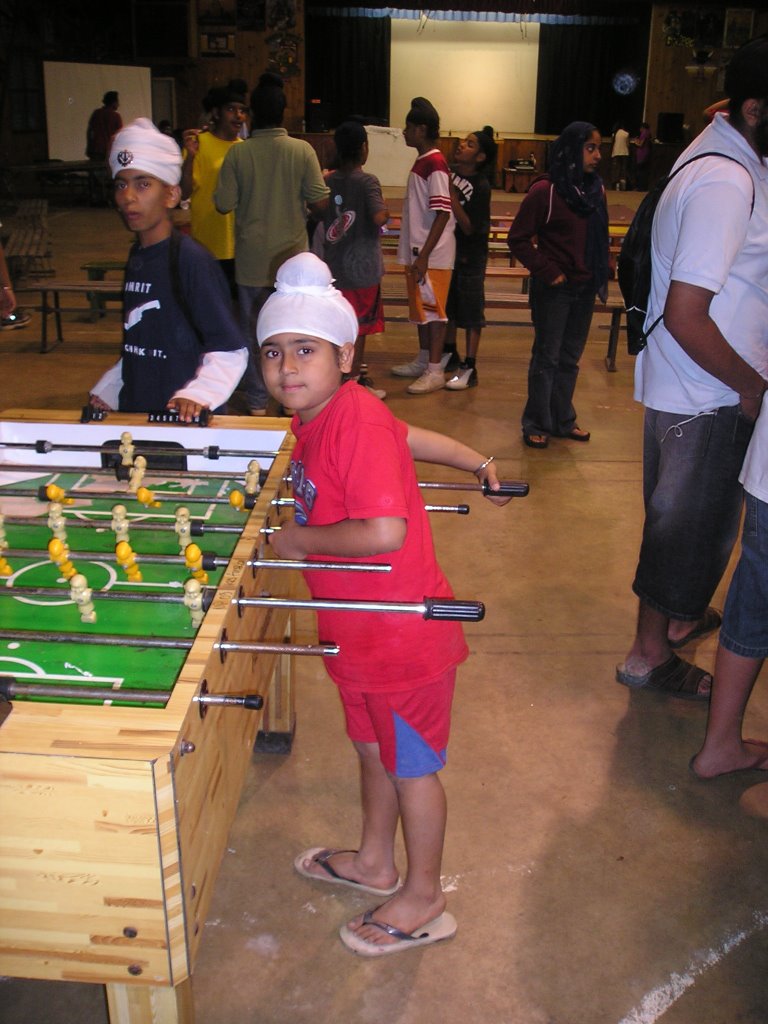
"Guys..where's M Singh!"..."I saw him playing foosball!!" This little one's sister was homesick so the parents came and took her home. He said he's gonna stay....he liked camp so much!
 Kīrtan, Gurū Rāmdās lulaby and Sohilā. It ran late so a couple of my kids fell asleep...woke them up for milk and cookies then it was..."Uncle, can we have a pillow fight tonight!!??"

Anyway, 1 week in TO to pack up and pretend to work as well. 1 week at Camp Chardi Kala in the Catskills, NY. 3 days in Boston/Chelmsford cleaning up for my move, 4 days in TO pretending to work, 3 days in Chelmsford receiving my goods from across the border. Throw in a couple of business dinners and early morning conference calls while I was pretending to work. It was a hectic 3 weeks
The stuff I will write about in the next couple of days is primarily Camp Chardi Kala. Surprise...you didn't think I would bore you with the exciting new stuff happening at work eh?
First this was the 30 year anniversary of Camp Chardi Kala. I have been volunteering there since approx. 1997 and had a few years hiatus due to personal reasons. This year we had 180 kids, I had a cabin full of about ten 8 and 9 year olds (boys)! That was quite an experience - I can now wash their hair, turn on and off the showers for them, of course tie their patkas, remind them to go take a pee before they go to bed, tell them sākhīs at night, allow them to do pillow fights even against the other cabins and say "We won" even though we got clobbered, play the panjabi game with them, listen to their jokes, not understand anything about the tv shows they watch (I just learnt about sponge bob!!), and soothe them when they felt homesick ("You are the son of Guru Gobind Singh aren't you!? Then why are you crying!?"). But for the life of me, I could not tie a tight jūrā on their heads which one day will don the crown of the Tenth Master. I know how uncomfortable I feel when my jūrā is not tight and secure...so I just could not let them be with untidy and loose jūrās, so I had to use rubber-bands. I don't get it! When my mom did my jūrā as a little kid she didn't have to use rubber bands to secure it...why can't I do it. After I comb their kes then I would have to hand them over to an auntyji or bhainji. I can do a gut (braid), but somehow the jura is never tight. Anyway, cabin duty for the young ones was a good (frustrating at times) introspective learning experience. Thanks Sandeep and Livleen Singh!! Anything but the 18 year olds!!
Here are some pics
Cabin #1 rocks! This is the table where my little guys sat for meals. The shatān one has to jump up last second and destroy the pic!
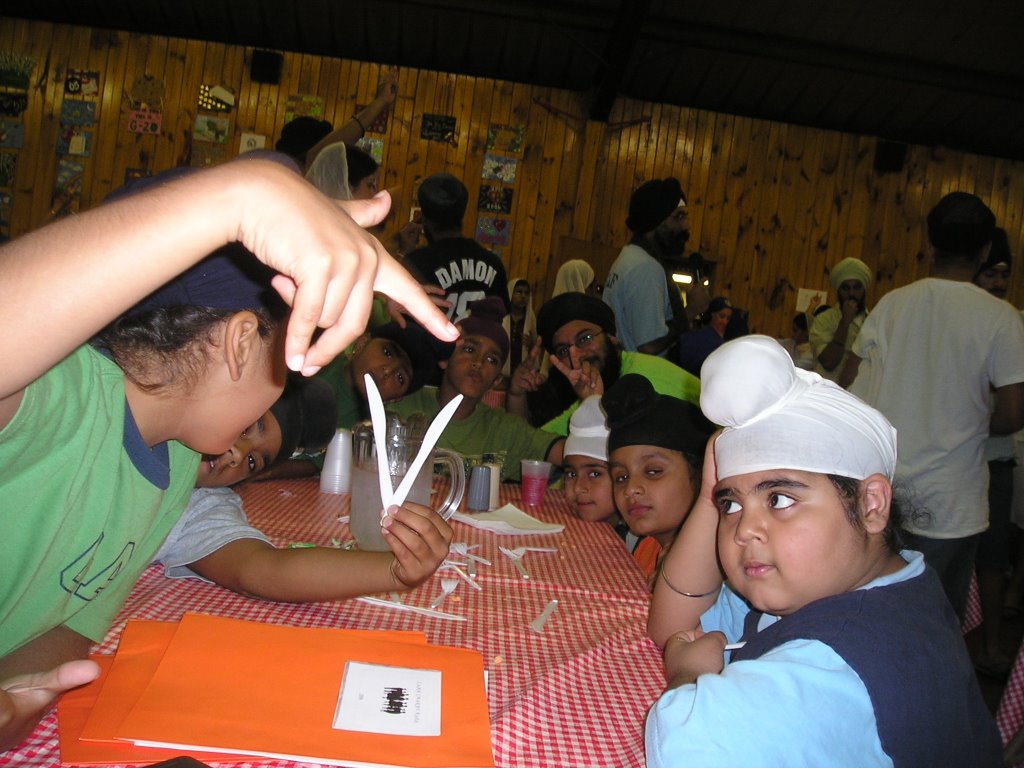
Click on pic for larger view. One on left is one of my kids. His jūrā is huge! I combed his kes, but could not do a proper jūrā for the life of me. Oh yeah, the one on the right, that's A Kaur's son..."umm....Yo A!...he's having a bad patkā day....AGAIN!
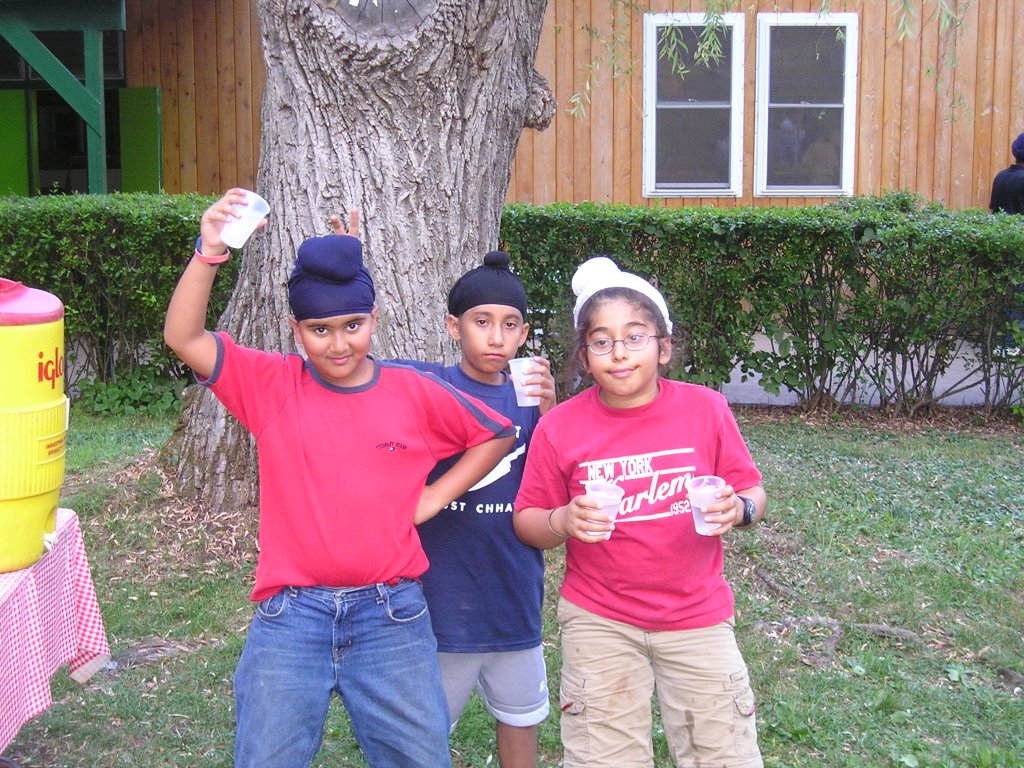
"Guys..where's M Singh!"..."I saw him playing foosball!!" This little one's sister was homesick so the parents came and took her home. He said he's gonna stay....he liked camp so much!
 Kīrtan, Gurū Rāmdās lulaby and Sohilā. It ran late so a couple of my kids fell asleep...woke them up for milk and cookies then it was..."Uncle, can we have a pillow fight tonight!!??"
Thursday, August 17, 2006
Rakhri day story...Shabash!
Rakhri day was last week. Many of you may have read about how this festival is demeaning to women. I wanted to share with you a story about what happened at Dixie Gurduara (Toronto) on Rakhri day.
It is usual, unfortunately, for ladies to go up to the railings that decorate the takht of Guru Granth Sahib in gurduaras and tie the rakhris onto the railing. I guess they consider the railings the arm of the Guru whom they consider their brother and maybe are seeking protection. Interesting concept...but NOT! Anyway, I saw a blog with pictures of that can't find it now, but hope you know what I mean.
Anyway, at Dixie Gurduara there are no railings around the Guru's takht so women just placed the rakhris right on top of the golak where other sangat members were placing money. By the end of evening divan, the whole golak was covered with rakhris.
During the divan, one Singhni from the sangat got up, picked up all the rakhris from the golak of the Guru, walked towards a garbage can and threw all the rakhris into the garbage. This was in clear view of all the women who had placed the rakhri.
1. When I heard this story, I said "Shabash!!".
2. The Singh who told it to me said "Do you know who the Singhni was?" Then he smiled and looked towards his wife.
3. I said "Vah vah! Good job". So it was a good friend of ours from the Toronto gang.
4. Apparently she got funny looks from the women in the sangat when she did that, but many Singhs came over and congratulated her for her thoughtful and courageous act after ardas.
I don't want to give out her name ...so.... "Good job N. Kaur!!"
Next year during rakhri day, I suggest we (all like minded Singhs and Kaurs) take turns at the Gurduara and every hour on the hour we take all the rakhris that have been left in front of the Guru's takht (or tied to the railings) and throw them in the garbage - preferably in front of the women that leave it there. In addition we hand out essays like the one below. It may hurt some women's feelings, but if we explain why we are doing it, then it may be worth it.
Thoughts?
-------
It is usual, unfortunately, for ladies to go up to the railings that decorate the takht of Guru Granth Sahib in gurduaras and tie the rakhris onto the railing. I guess they consider the railings the arm of the Guru whom they consider their brother and maybe are seeking protection. Interesting concept...but NOT! Anyway, I saw a blog with pictures of that can't find it now, but hope you know what I mean.
Anyway, at Dixie Gurduara there are no railings around the Guru's takht so women just placed the rakhris right on top of the golak where other sangat members were placing money. By the end of evening divan, the whole golak was covered with rakhris.
During the divan, one Singhni from the sangat got up, picked up all the rakhris from the golak of the Guru, walked towards a garbage can and threw all the rakhris into the garbage. This was in clear view of all the women who had placed the rakhri.
1. When I heard this story, I said "Shabash!!".
2. The Singh who told it to me said "Do you know who the Singhni was?" Then he smiled and looked towards his wife.
3. I said "Vah vah! Good job". So it was a good friend of ours from the Toronto gang.
4. Apparently she got funny looks from the women in the sangat when she did that, but many Singhs came over and congratulated her for her thoughtful and courageous act after ardas.
I don't want to give out her name ...so.... "Good job N. Kaur!!"
Next year during rakhri day, I suggest we (all like minded Singhs and Kaurs) take turns at the Gurduara and every hour on the hour we take all the rakhris that have been left in front of the Guru's takht (or tied to the railings) and throw them in the garbage - preferably in front of the women that leave it there. In addition we hand out essays like the one below. It may hurt some women's feelings, but if we explain why we are doing it, then it may be worth it.
Thoughts?
-------
Rakhri - A Symbol of Oppression Against Women
by Harpreet Singh (Sat Aug 04, 2001 www.Sikhe.com)
Since times immemorial, minorities all over the world have sought comfort through conformism. They have often adopted practices that are antithetical to their own beliefs. We need not go very far for examples. Guru Nanak, for instance, in the Asa Kee Vaar shows the conformism and resulting hypocrisy of Brahmins as they attempt to please their masters and maintain their caste hierarchy.
…They wear their loin cloths, apply ritual frontal marks to their foreheads, and carry their rosaries, but they eat food with the Muslims. O Siblings of Destiny, you perform devotional worship indoors, but read the Islamic sacred texts, and adopt the Muslim way of life. Renounce your hypocrisy. Embrace the true Lord, and attain salvation.
The man-eaters say their prayers. Those who wield the knife wear the sacred thread around their necks . . . Wearing blue robes, they seek the approval of the Muslim rulers. Accepting bread from the Muslim rulers, they still worship the [Hindu] Puraanas. They eat the meat of the goats, killed after the Muslim prayers are read over them, but they do not allow anyone else to enter their kitchen areas. They draw lines around them, plastering the ground with cow-dung. The false come and sit within them. They cry out, "Do not touch our food, or it will be polluted!" But with their polluted bodies, they commit evil deeds. With filthy minds, they try to cleanse their mouths. Says Nanak, meditate on the True Lord. If you are pure, you will obtain the True Lord.
Raag Asa, M. 1, SGGS, p. 471-72
Clearly, conformism is unacceptable to Guru Nanak, who created a sovereign and a defiant race of human beings through his revolution. Unfortunately, some Sikhs today under the influence of Brahminism have become conformists. As a compelling example, let's examine the festival of Rakhri that is celebrated today by many Sikhs who are ignorant of its significance. First, some background grounded in its hoary mythology is in order.
One of the two festivals celebrated during the bright fortnight during the Hindu month of Shravan is Raksha Bandhan, better known as Rakhri among Punjabi Hindus. It is a tradition with ancient roots. Bhavishya Purana refers to a fierce battle that raged between the gods and the demons. From news received from the battlefield it appeared that the demons were getting the upper hand and would gain victory.
Indra, the supreme Hindu deity, summoned his teacher Vrihaspati to his court for advice. Indra's wife Indrani was also present. Before the teacher could speak, Indrani rose and said, "I know how to assure the victory of the gods. I give you my word that we will win." The next day was full moon night of the month Shravan. Indrani had a charm prepared as prescribed by the sacred texts and tied it on the wrist of her husband. And no sooner did Indra appear on the battlefield with the charm on his hand the demons scattered and fled. The demons bit the dust and the gods were victorious.
It would appear that the Raksha Bandhan of today is derived from this belief. It is held that if a chord made according to the prescriptions of the holy texts is tied round the wrist of a person on the full moon day of Shravan it will ensure him good health, success and happiness for the year that follows.
Rakhri has become a sacred festival for Hindus. Sisters tie amulets to brothers. Brahmin Priests tie them to the men of their congregations. Also on this day, it is noteworthy that the Brahmins change their sacred thread, janeoo, which Guru Nanak rejected at a young age because it symbolizes apartheid though its stratification of society. In
Today Rakhri (literally meaning protection) has become popularized as an annual event in Hindu religion where sisters tie amulets to their brothers and seek the male's protection in exchange. The woman conducting aarti before her brother, a ritual Guru Nanak repudiates in the Kirtan Sohila, sometimes precedes the thread-tying ceremony. This is to the accompaniment of her enunciation or chanting of the following mantra in Sanskrit. Yena baddho balee raajaa daanavendro mahaabalah. Tena twaam anubadhnaami rakshey maa chala maa chala. "I am tying on your hand this Raksha, with which the most powerful and generous King Bali himself was bound; O Raksha, don't go away; don't go away."
From a Sikh perspective, Rakhri is undoubtedly another expression of a patriarchal culture, however well intentioned. It is, after all, the brother who extends his protection to his sister, and the woman who agrees to place herself under the protection of her brother. She is devoid of power and must turn to a male for protection. While this is true in Hinduism, where the law giver Manu gives her a place next to animals, it is not the case in Sikhism. Guru Nanak, in his Asa Kee Var, raised the status of woman, making her equal to man long before
How do we reconcile the celebration of a festival so antithetical to Sikhism by Sikhs ? Five hundred years of work by the Sikh Gurus to give women their basic human rights is undercut through such demeaning rituals imbued in Brahminism. Does not the tenth Nanak declare, "When the Khalsa adopts Brahminical ways, it shall lose my trust", jab eh gahe bipran kee reet, mai na karoo in kee parteet?
Guru Nanak demands complete sovereignty through actions. There is no room for conformism and compromises. Sikh women worldwide should resolve to boycott festivals such as Rakhri that dilute the egalitarian message of Sikhism. What could be a better tribute that can be offered to our Ten Masters who fought to give women equal rights when the rest of the world turned a blind eye to oppression against them ?
Harpreet Singh is an information technology professional and a committed, active Sikh. He is the founder of the successful Sikh Heresy Regulation Board that spearheads active campaigns to prevent lapses in the practice of the Sikh faith.
Thursday, August 10, 2006
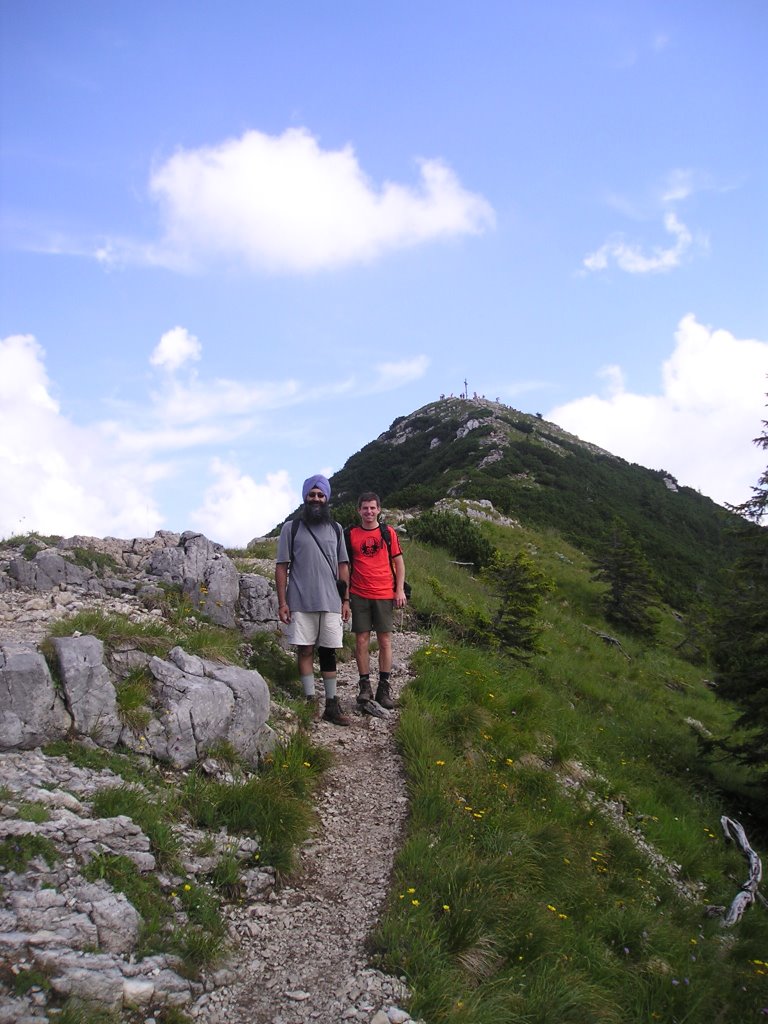
Breckerspitze und Ankl Alm
I have to share some of the pictures from my first hiking trip in the Bavarian Alps. Because this mountain is so close to Munich (just 35 minute drive) this is part of what is called the Hausberg (the House Mountains of Munich). I have to thank my colleague - Claus Rottlaender for taking me along with some of his friends who were avid hikers!
A couple of short comments. One - after a long time I really got to do some real hiking. Toronto area is not conducive to hiking...there are no hills. Yup, forget about mountains, they don't even have any decent hills to hike on. So for three years in Toronto didn't get to do any decent hiking...although there was a short camping trip to Alguanquin (sp?). Also in early July I was in San Antonio for Sidak and there was a outdoor activity - a hike around "Enchanted Rock". Well, yes...it was a rock, no trees, a little bit of greenery, but not a "real hike". It was fun, but not hiking. This trip to Breckerspitze (the name of the peak), now that was a HIKE! It is 1640 meters above sea level. Its one of the easiest ones in the Bavarian region my colleague says! But boy what a workout I got! It was worth it and to prove it check out some shots below!
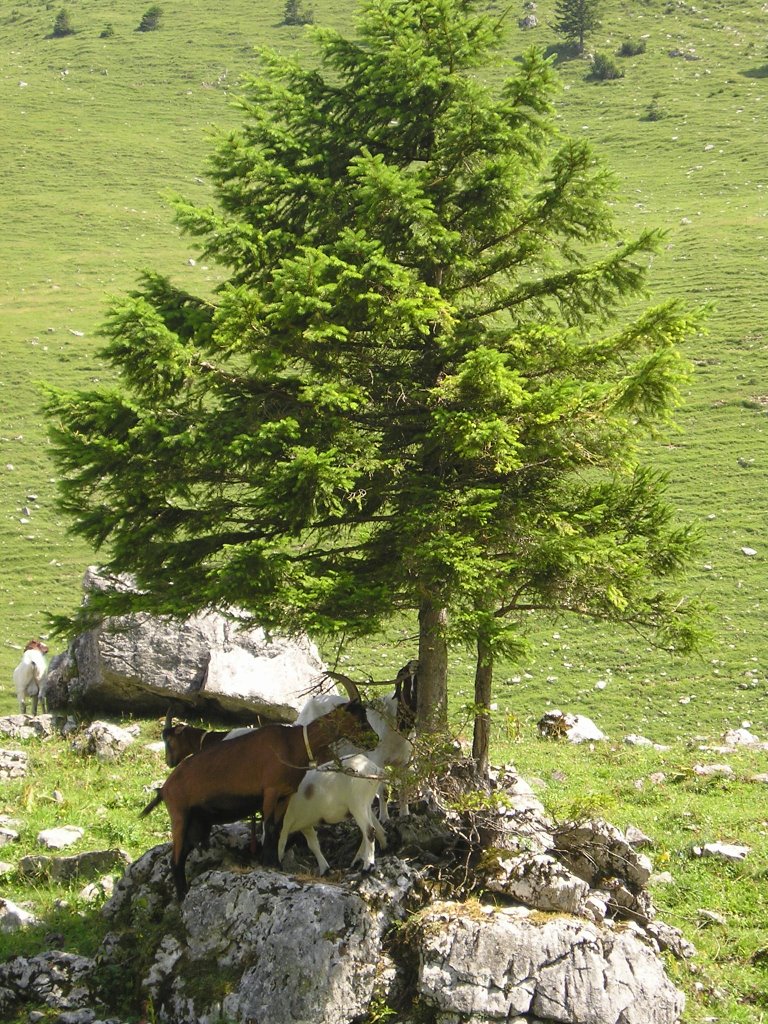
Along the way to the peak was a place of rest (farm house) also called an Alm. This was Ankl Alm. We stopped by it on the way down. 'Twas very quaint and traditional. They served fresh buttarmilch (buttermilk or Lassi!!) but I had an Apfelschorle instead. If I had the lassi, I would have passed out and fallen asleep right there...I was tired on the way down too! This place had a watering tub for the cows and goats. Cows were having their afternoon tea (water) while many hikers were having their wiesbeer, buttarmilch, apfelschorle etc. Way cool!
Carhdi kala!
--------------
click on the pics to get a better view....
Begin the journey...
 I already started getting tired...but had to take some shots

Click on this one and you can see the cows. The little house is the Ankl Alm.
 Pretty much at the top now, pretty cool view of the town below...
 Breckerspitze is actually surrounded by three lakes. Don't ask me the names of the lakes...

Claus took a picture of me....he said I have to get the lake in the background. Easy now, don't fall over the edge...
Claus' friend, Bernd, and myself. We have started the descent...but first visit the chapel...
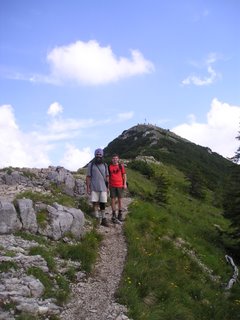
A catholic chapel way up on the mountain. The Germans actually went in and prayed I think. It was Sunday...
"bhavar tumara eh manu hovohu hari carna hoai kaula..." Back near the Alm the goats fighting for the shade...
 It was tiring but great. Gotta do one more hike before I leave Germany at the end of October.

A couple of short comments. One - after a long time I really got to do some real hiking. Toronto area is not conducive to hiking...there are no hills. Yup, forget about mountains, they don't even have any decent hills to hike on. So for three years in Toronto didn't get to do any decent hiking...although there was a short camping trip to Alguanquin (sp?). Also in early July I was in San Antonio for Sidak and there was a outdoor activity - a hike around "Enchanted Rock". Well, yes...it was a rock, no trees, a little bit of greenery, but not a "real hike". It was fun, but not hiking. This trip to Breckerspitze (the name of the peak), now that was a HIKE! It is 1640 meters above sea level. Its one of the easiest ones in the Bavarian region my colleague says! But boy what a workout I got! It was worth it and to prove it check out some shots below!
Along the way to the peak was a place of rest (farm house) also called an Alm. This was Ankl Alm. We stopped by it on the way down. 'Twas very quaint and traditional. They served fresh buttarmilch (buttermilk or Lassi!!) but I had an Apfelschorle instead. If I had the lassi, I would have passed out and fallen asleep right there...I was tired on the way down too! This place had a watering tub for the cows and goats. Cows were having their afternoon tea (water) while many hikers were having their wiesbeer, buttarmilch, apfelschorle etc. Way cool!
Carhdi kala!
--------------
click on the pics to get a better view....
Begin the journey...
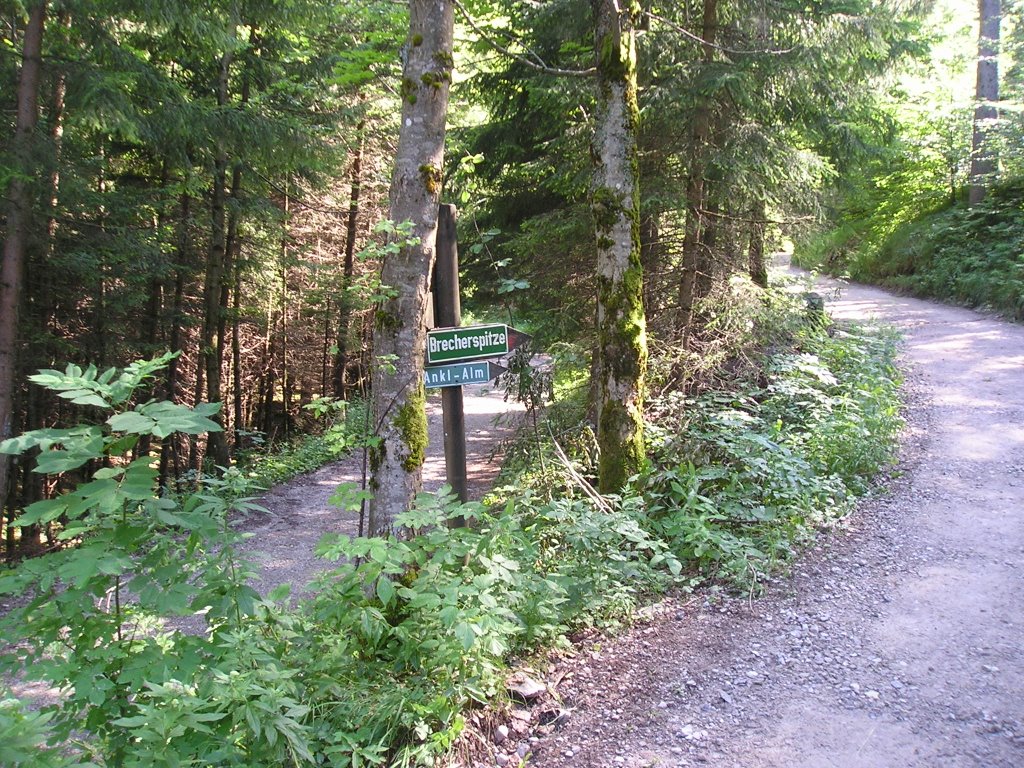 I already started getting tired...but had to take some shots
Click on this one and you can see the cows. The little house is the Ankl Alm.
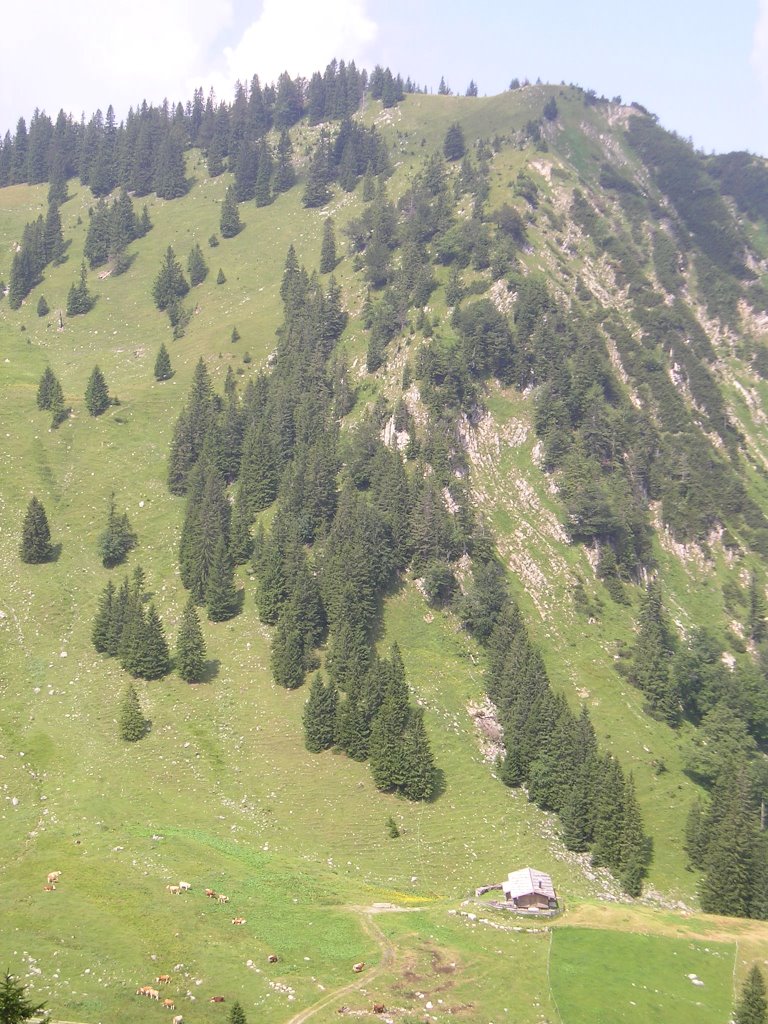 Pretty much at the top now, pretty cool view of the town below...
 Breckerspitze is actually surrounded by three lakes. Don't ask me the names of the lakes...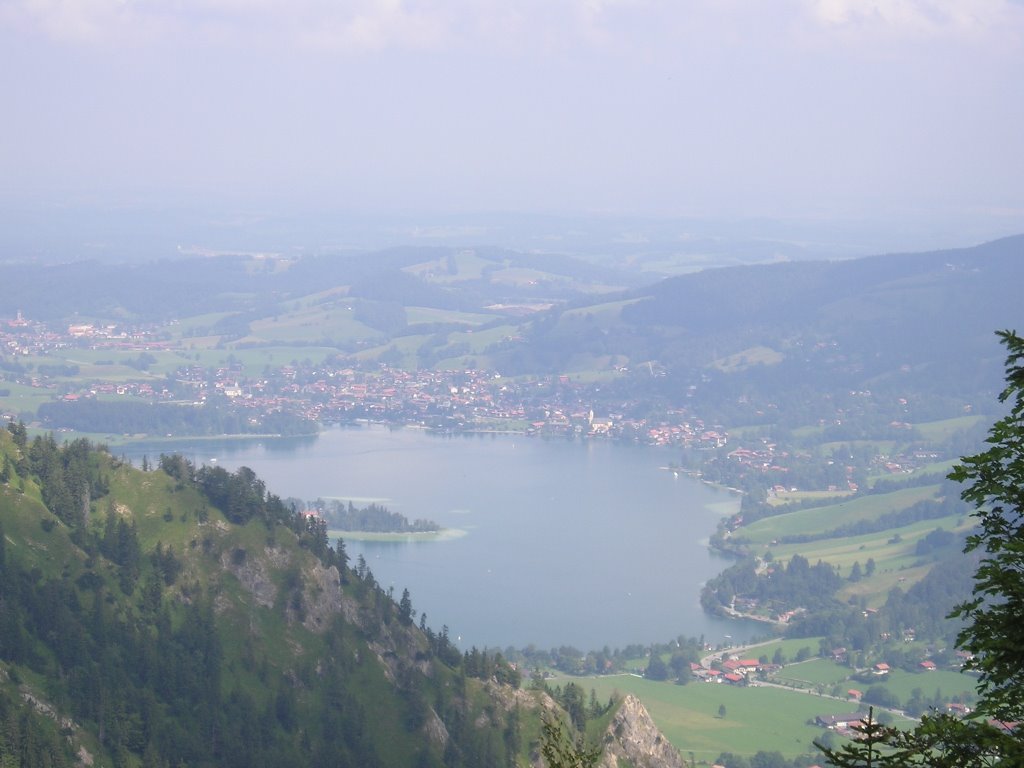
Claus took a picture of me....he said I have to get the lake in the background. Easy now, don't fall over the edge...

Claus' friend, Bernd, and myself. We have started the descent...but first visit the chapel...
A catholic chapel way up on the mountain. The Germans actually went in and prayed I think. It was Sunday...

"bhavar tumara eh manu hovohu hari carna hoai kaula..."
 Back near the Alm the goats fighting for the shade...
 It was tiring but great. Gotta do one more hike before I leave Germany at the end of October.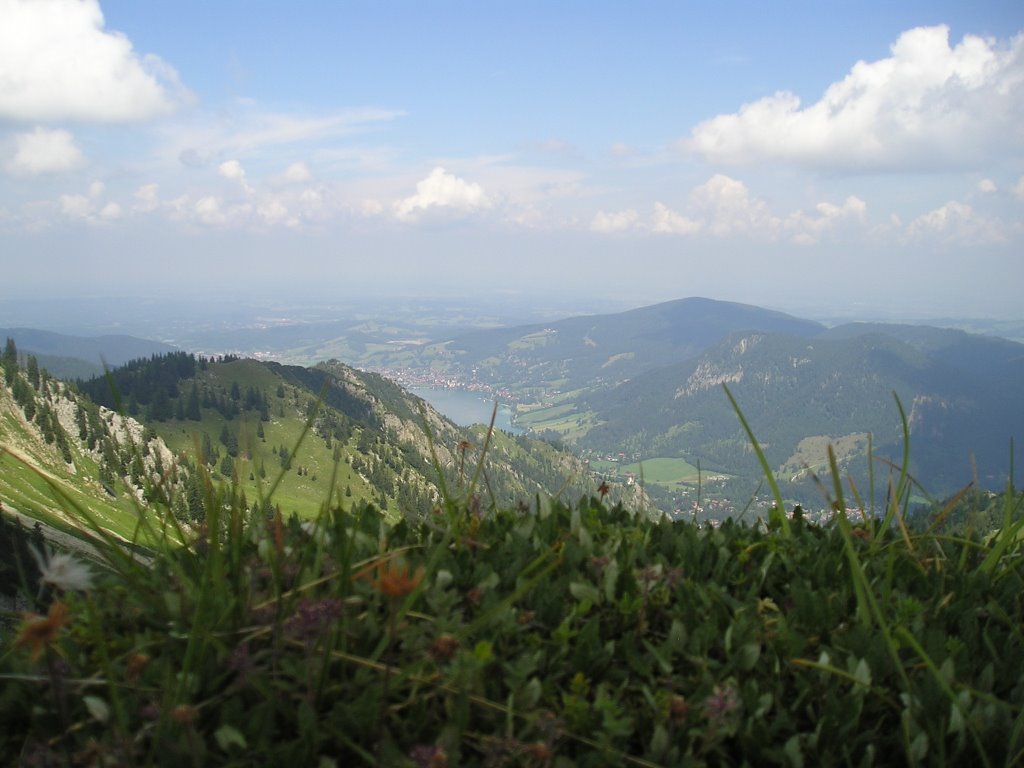
Sikhs against Genocide
Indeed it was a unique event in the history of Sikh youth programs in the Greater Toronto Area. Sikhs need to be relavent to the world, and this program showed that we can be. June 25th, 2006 at Rexdale Gurduara was the program. Very well executed and it was a result of the dedication of a few young energetic Guru ke Sikhs. The one that deserves most of the credit is young Sardar Tejdeep Singh. I asked him what inspired him to take on this seva. "I was walking one day and my thoughts were wandering and I said I should do this". That is exactly it!! Instinct. A Sikh's instinct must be for the benefit of society and community. When instinct is developed as a result of the confluence of Faith, Discipline and Courage - that is known as Sidak. Here is the Singh himself!!
 Nampreet Singh and jatha started off with "ek pita, ekas ke ham barak, tu mera gurhai...". Well done rendition of a sabad rit as found in Bhai Avtar Singh Bhai Gurcharan Singh's book. Accompanying him were Karanjeet Singh on Rabab and Jaswinder Singh on Jori.
 Then there were some speeches from Sikh, Sudanese as well as local Canadian Human Rights activists. Overall an excellent program that raised awareness about the need for action in all parts of the world against Genocide!
 Nampreet Singh and jatha started off with "ek pita, ekas ke ham barak, tu mera gurhai...". Well done rendition of a sabad rit as found in Bhai Avtar Singh Bhai Gurcharan Singh's book. Accompanying him were Karanjeet Singh on Rabab and Jaswinder Singh on Jori.
 Then there were some speeches from Sikh, Sudanese as well as local Canadian Human Rights activists. Overall an excellent program that raised awareness about the need for action in all parts of the world against Genocide!
Sunday, August 06, 2006
Mom, sigh! What will become of me?
It's not that I only have one fault in me that I can wash away and become pure. My Divine Spouse is awake and I am asleep all throughout the night. In this state of being, there is no way my Divine Spouse will be attracted to me, will love me. My Divine Spouse is awake and I am asleep all throughout the night.-------
I come and lay on the bed, full of desires, wants and unfulfilled dreams. In this state of being, will I be able to please my Divine Spouse or will I not? Dear mother. Sigh! What will become of me? I can't survive without the Spiritual (vision-like) Connection with the Divine Spouse!
I have yet to relish the Love Taste of my Divine Spouse, so my desires remain unfulfilled. My youth has passed by and now my old body aches in frustration. There is still a possibility that I may wake up from this sleep of desires and want, by becoming desireless and in a state of fulfillment.
If the Soul Bride's only decoration and makeup is the discarding of haumai, then the Divine Spouse comes and unites in the Bed of the Heart. Nanak reveals: when the Soul Bride renounces self and submerges in the ocean of Divine Will, then the Divine Spouse is immensely pleased.
I have been away from the blogging scene for quite a while. A trip to India, San Antonio (TX) for the Sidak program, busy with work, hiking trip in the Bavarian Alps last weekend, and this past weekend I was in Italy (Reggio Emilia?) for a AKJ samagam...life is quite busy.
I had prepared this transcreation of a very touching a powerful sabad. Its in Rag Asa from page 356 of Guru Granth Sahib. Interestingly it has four rahau di tuks instead of one. Each line of the sabad expresses a state of being which is the progression towards a state of 'onenes' with Vahguru. I'm still stuck at the first state, btw. And it is also quite interesting how the imagery of a young bride seeking solace and advise from her mother is portrayed. So many times when we are in a bind, the first one to call upon is Mom. Guru Nanak knew human emotions well, he relates with us.
I have a recording of Bhai Bakshish Singh who used to sing this rit of this sabad...I have heard the live version in a CD of a live Asa ki Var in Vancouver recorded in 1978. But this is a studio recording and is equally good. I will post it up here soon once I figure out how to do that. In the mean time folks can search for it (bhai bakshish singh - kya jana kya hoyega ri mai...)
Sabad is given below.
ਆਸਾ ਮਹਲਾ 1 ॥
ਏਕ ਨ ਭਰੀਆ ਗੁਣ ਕਰਿ ਧੋਵਾ ॥ ਮੇਰਾ ਸਹੁ ਜਾਗੈ ਹਉ ਨਿਸਿ ਭਰਿ ਸੋਵਾ ॥1॥
ਇਉ ਕਿਉ ਕੰਤ ਪਿਆਰੀ ਹੋਵਾ ॥ ਸਹੁ ਜਾਗੈ ਹਉ ਨਿਸ ਭਰਿ ਸੋਵਾ ॥1॥ ਰਹਾਉ ॥
ਆਸ ਪਿਆਸੀ ਸੇਜੈ ਆਵਾ ॥ ਆਗੈ ਸਹ ਭਾਵਾ ਕਿ ਨ ਭਾਵਾ ॥2॥
ਕਿਆ ਜਾਨਾ ਕਿਆ ਹੋਇਗਾ ਰੀ ਮਾਈ ॥ ਹਰਿ ਦਰਸਨ ਬਿਨੁ ਰਹਨੁ ਨ ਜਾਈ ॥1॥ ਰਹਾਉ ॥
ਪ੍ਰੇਮੁ ਨ ਚਾਖਿਆ ਮੇਰੀ ਤਿਸ ਨ ਬੁਝਾਨੀ ॥ ਗਇਆ ਸੁ ਜੋਬਨੁ ਧਨ ਪਛੁਤਾਨੀ ॥3॥
ਅਜੈ ਸੁ ਜਾਗਉ ਆਸ ਪਿਆਸੀ ॥ ਭਈਲੇ ਉਦਾਸੀ ਰਹਉ ਨਿਰਾਸੀ ॥1॥ ਰਹਾਉ ॥
ਹਉਮੈ ਖੋਇ ਕਰੇ ਸੀਗਾਰੁ ॥ ਤਉ ਕਾਮਣਿ ਸੇਜੈ ਰਵੈ ਭਤਾਰੁ ॥4॥
ਤਉ ਨਾਨਕ ਕੰਤੈ ਮਨਿ ਭਾਵੈ ॥ ਛੋਡਿ ਵਡਾਈ ਅਪਣੇ ਖਸਮ ਸਮਾਵੈ ॥1॥ ਰਹਾਉ ॥26॥
Thursday, June 15, 2006
The Crown of Martyrs - ਸ਼ਹੀਦਾਂ ਦੇ ਸਿਰਤਾਜ - shahīdān de sirtāj
ੴ ਸਤਿਗੁਰਪ੍ਰਸਾਦਿ
ਜੋਤਿ ਰੂਪਿ ਹਰਿ ਆਪਿ ਗੁਰੂ ਨਾਨਕੁ ਕਹਾਯਉ ॥
ਤਾ ਤੇ ਅੰਗਦੁ ਭਯਉ ਤਤ ਸਿਉ ਤਤੁ ਮਿਲਾਯਉ ॥
ਅੰਗਦਿ ਕਿਰਪਾ ਧਾਰਿ ਅਮਰੁ ਸਤਿਗੁਰੁ ਥਿਰੁ ਕੀਅਉ ॥
ਅਮਰਦਾਸਿ ਅਮਰਤੁ ਛਤ੍ਰੁ ਗੁਰ ਰਾਮਹਿ ਦੀਅਉ ॥
ਗੁਰ ਰਾਮਦਾਸ ਦਰਸਨੁ ਪਰਸਿ ਕਹਿ ਮਥੁਰਾ ਅੰਮ੍ਰਿਤ ਬਯਣ ॥
ਮੂਰਤਿ ਪੰਚ ਪ੍ਰਮਾਣ ਪੁਰਖੁ ਗੁਰੁ ਅਰਜੁਨੁ ਪਿਖਹੁ ਨਯਣ ॥1॥
ਜੋਤਿ ਰੂਪਿ ਹਰਿ ਆਪਿ ਗੁਰੂ ਨਾਨਕੁ ਕਹਾਯਉ ॥
ਤਾ ਤੇ ਅੰਗਦੁ ਭਯਉ ਤਤ ਸਿਉ ਤਤੁ ਮਿਲਾਯਉ ॥
ਅੰਗਦਿ ਕਿਰਪਾ ਧਾਰਿ ਅਮਰੁ ਸਤਿਗੁਰੁ ਥਿਰੁ ਕੀਅਉ ॥
ਅਮਰਦਾਸਿ ਅਮਰਤੁ ਛਤ੍ਰੁ ਗੁਰ ਰਾਮਹਿ ਦੀਅਉ ॥
ਗੁਰ ਰਾਮਦਾਸ ਦਰਸਨੁ ਪਰਸਿ ਕਹਿ ਮਥੁਰਾ ਅੰਮ੍ਰਿਤ ਬਯਣ ॥
ਮੂਰਤਿ ਪੰਚ ਪ੍ਰਮਾਣ ਪੁਰਖੁ ਗੁਰੁ ਅਰਜੁਨੁ ਪਿਖਹੁ ਨਯਣ ॥1॥
ਭੱਟ ਮਥੁਰਾ,
ਗੁਰੁ ਗ੍ਰੰਥ ਸਾਹਿਬ, ਪੰਨਾ 1409
ਗੁਰੁ ਗ੍ਰੰਥ ਸਾਹਿਬ, ਪੰਨਾ 1409
One Integrative Force Truth Gurū Grace
The embodiment of the Divine Light, they call you Gurū Nānak
Then became he a part of your body, the essence merged with the essence
By the grace of Gurū Angad, the prophethood was bestowed on Guru Amardās
Gurū Amardās raised the sovereign spiritual canopy over the head of Rāmdās
Upon the merciful glance of Gurū Rāmdās, his life was made nectar-like
The fifth embodiment of the Divine Light is inaugurated; behold with your eyes - Gurū Arjan!
The embodiment of the Divine Light, they call you Gurū Nānak
Then became he a part of your body, the essence merged with the essence
By the grace of Gurū Angad, the prophethood was bestowed on Guru Amardās
Gurū Amardās raised the sovereign spiritual canopy over the head of Rāmdās
Upon the merciful glance of Gurū Rāmdās, his life was made nectar-like
The fifth embodiment of the Divine Light is inaugurated; behold with your eyes - Gurū Arjan!
Mathura the Minstrel,
Gurū Granth Sāhib, Pg. 1409
Gurū Granth Sāhib, Pg. 1409
~-~-~-~-~-~-~-~
ਗੁਰ ਅਰਜੁਨ ਕਲ੍ਹੁਚਰੈ ਤੈ ਰਾਜ ਜੋਗ ਰਸੁ ਜਾਣਿਅਉ
ਭੱਟ ਕਲ
ਗੁਰੂ ਗ੍ਰੰਥ ਸਾਹਿਬ - ਪੰਨਾ 1407
ਗੁਰੂ ਗ੍ਰੰਥ ਸਾਹਿਬ - ਪੰਨਾ 1407
Gurū Arjan! You truly relish and command possession of rāj-jog
(Doctrine of Double Sovereignty)
(Doctrine of Double Sovereignty)
Kal the Minstrel
Gurū Granth Sāhib, Pg. 1407
Gurū Granth Sāhib, Pg. 1407
~-~-~-~-~-~-~-~
The First Prophet of the Sikh Revolultion raised the banner of dissent against the unjust and tyrannical means by which Bābar took over Hindostān. The Epitome of Obedience ignored the arrogance of the defeated temporal sovereign Humāyūn. He was teaching the children and did not care for unscrupulous people of status. The Incomparable Prophet insisted that the ruler of the time, Akbar, shed his opulence and status and have a meal with the commoners. It was only after that act did our Beloved Sovereign allow an audience. Then we know that the Founder of the City of Then came the “Crown of Martyrs“, our beloved Gurū Arjan. After establishing the worldwide center for Sikh spiritual inspiration (Harimandir Sahib), compiling the Ādī Granth and inaugurating the bānī in its sanctum sanctorium, participating in protests against unjust taxes, establishing yet another Sikh community center and city (Tarn Tāran), and tending to the needs of his people, Gurū Arjan perfomed the miracle of miracles. According to Prof. Puran Singh he was a “prophet, poet, composer of music, passionate lover of the people, architect, saviour“ and he was also “intensely human“. He performed the miracle of putting mislead rulers in their place and of beating the Brahmin at their game of manipulation and dominance. He made the choice of giving up his worldly life and allowing it to come to an end. As we will see, by his choice what he really did was allow his life giving inspiration to live on forever.
Since the time of Gurū Arjan Sāhib‘s martyrdom, the Sikh Nation and indeed the whole world knows and understands that the tradition of martyrdom is part and parcel of the Sikh psyche. Whenever there is a choice – death or freedom – then the majority of Sikhs in our history have chosen death. And the precedent for that choice was established by our Fifth Master. It was the Guru’s model, the example, and the inspiration that would lead hundreds of thousands of Sikhs to choose “death as their bride” rather than live wretched lives of slavery and domestication.
Gurū Arjan taught the technique of martyrdom to his Sikhs. Historians point out that he met his physical death with great peace, equipoise, resilience, steadfastness, resolve, compassion, perseverance, and oneness with the Ultimate Reality. So much so that when red hot sand was poured down his back he kept on uttering “Glory, Glory” and “Sweet is Thy doing!”. He was so steadfast in his convictions that he reprimanded his best friend Saint Mian Mir for attempting to seek pardon from the authorities.
Many followed in his footsteps. First was our beloved Master the Brave Swordbearer (Teghbahadar) Nānak IX who made the same choice and passed on with similar peace and steadfastness as his grandfather. Along with him Bhāī Matī Dās, Bhāī Satī Dās, Bhāī Dayālā made the choice. Then came the four sāhibzādās, the forty mukate, Bandā Singh Bahādur, hundreds of his comrades including the young Sikh soul who disowned his mother for daring to say he was not a Sikh. A sampling of the countless more may include the likes of Bhāī Mani Singh who insisted to be cut apart joint by joint, Bhāī Tārū Singh the gentle yet victorious lion of the Gurū who parted not with his kes but rather his scalp, Bābā Gurbaksh Singh (Nihang) and his 30 Singh companions who fought until death to protect our sacred Harimandir Sahib, father and son Bhāī Subeg Singh and Bhāī Shāhbāz Singh who were crushed on the wheel, and the numerous Sikh mothers who wore garlands of their children‘s limbs in the jails of Mīr Mannū. Then how can we forget Bībī Balbīr Kaur of the Gurū kā Bāgh Morcā fame along with her temporary gift from Vāhgurū[1]. In our recent history, Bābā Jarnail Singh of village Bhindrān, Bhāī Amrīk Singh, Bhāī Thārā Singh, General Shabeg Singh, our brothers Sukhā and Jindā, Beant Singh, Satwant Singh, Jathedār Gurdev Singh of village Kaonke and the unnamed mothers, wives, daughters and sisters that were butchered in the Tījā Ghalūghārā; the list of names is endless and so is their memory. Every drop of blood, every pinch of ash and every echo of the sound of the Gurū‘s word that came from their mouth has helped shape our tradition of martydom and allow for its sustenance in the ages to come. There can be no question of that.
The significance of the Shahīdī Gurpūrab of Panjve Pātshah is that it marks the opening of the spillways of the dam that blocked the reservoir of Sikh blood which then flowed into our history to make sacred our land, our faith and our culture.
It is distressing to have read the words of certain men and women of so called “academic circles” that are trying to discredit our tradition of shahīdī[2]. Some historians have given weird reasons for Guru Arjan Sāhib‘s martyrdom. They know not that we, the Sikhs, are a haughty lot. The Sikhs don‘t need some orientalist or athiest inspired researchers defining or reinterpreting our traditions. We know who were are. However, we are also a forward thinking, open minded and compassionate lot. Let them study our hearts and the manners of our manifestations of love. We know who we are and we need no logical explanation of our attachement to our Guru. It is just like the case of a child that has this inherent sixth sense for his or her mother‘s touch. It automatically soothes and makes a crying volcano into a giggly babe. When our minds envision Gurū Arjan on the red hot ironplate, and when our ears hear him reveal “ ‘Tis sweet, whatever Thou doest oh Vāhgurū, Nanak only seeks the treasure of Internal Rememberance“[3], then our souls are automatically cooled and our convictions are immediately made steadfast. There is no logic or science behind it. There is only experience and feeling.
And on this day, the anniversary of the martyrdom of the “Crown of Martyrs”, let us experience and feel. Let us beg for even an iota of courage and faith that our ancestors had when faced with the ultimate choice. Let us not forget our tradition of shahīdī and cherish the memories of those made immortal by following it.
I end with poem on “martyrology“, a unique Sikh inspired term I guess. It is written by Harmohanjit Singh from his book of poems: Sugar, Steel and the Maple Leaf.
The Supreme Martyr
By Harmohanjit Singh
Guru Arjan made the original sacrifice,
Selecting to roll death‘s dice,
Paying an ulimate price.
The Supreme Martyr,
The first to refuse to barter,
Compiler of our cherished charter.
His stance was too unfashionable,
Path proving so unflappable,
Wrath unfathomable.
Earth angel arrested,
Temporal temptation tested,
Spiritual resolution never rested.
Readily facing his physical fate,
Feeling zero anger and hate,
Inspiring heroes in-wait.
When up rose his hand,
Down fell hot beads of sand,
Like a hellish hourglass on demand.
By day the sun shone less brilliantly,
But his son went on resiliently,
Reigning just as valiantly.
Victory went to Waheguru,
Wile Sikh history began anew,
And our martyrology grew and grew.
By Harmohanjit Singh
Guru Arjan made the original sacrifice,
Selecting to roll death‘s dice,
Paying an ulimate price.
The Supreme Martyr,
The first to refuse to barter,
Compiler of our cherished charter.
His stance was too unfashionable,
Path proving so unflappable,
Wrath unfathomable.
Earth angel arrested,
Temporal temptation tested,
Spiritual resolution never rested.
Readily facing his physical fate,
Feeling zero anger and hate,
Inspiring heroes in-wait.
When up rose his hand,
Down fell hot beads of sand,
Like a hellish hourglass on demand.
By day the sun shone less brilliantly,
But his son went on resiliently,
Reigning just as valiantly.
Victory went to Waheguru,
Wile Sikh history began anew,
And our martyrology grew and grew.
[1] In Sikh tradition a “child” of Gursikh parents is considered the amānat of Vāhigurū that is temporarily put in the care of the parents. Bibi Balbir Kaur is known to have placed her dead child (shot by a British bullet) on a mound while saying “Vāhgurū apni amānat vāpas leh lai” (Vāhguru, please take back Your belonging which you temporarily put in my care…). She then proceeded to get shot by a bullet and attained martyrdom. Please read “Adarshak Singhnian” by Karam Singh.
[2] Yes, McLeod and his disciples have also worked hard to discredit and confuse our cherished concept of martyrdom by so called “historical analysis”. Please read: Martyrdom in the Sikh Tradition: Playing the ‘Game of Love’, Louis F. Fenech,
[3] ਤੇਰਾ ਕੀਆ ਮੀਠਾ ਲਾਗੈ॥ ਹਰਿ ਨਾਮੁ ਪਦਾਰਥੁ ਨਾਨਕੁ ਮਾਂਗੈ ॥ terā kīā mīthā lāgai. hari namu padārathu nānaku māngai.
Wednesday, June 14, 2006
Football is Religion
I have come to realize that here in Europe, and also many other parts of the world, Football (known as soccer in America/Canada) is practically religion. I was in Rome a couple months ago and chatting with a taxicab driver. 2 months ago, the topic during our short cab ride was World Cup Football. He told me in most countries in the world, Football is religion! He said Northern Europeans celebrate football by getting drunk. Italians celebrate by eating. My visit to Rome was indeed a culinary delight.
Anyway...it is not possible to not be enthused and excited by the Football craze that has taken over the cities here in Germany. Here is one shot from yesterday's game between Brazil and Croatia. Brazil won, but the Croatian team did exceedingly well in both defence and offence. This picture is courtesy BBC and can be found here. A fan is falling at the feet of one of Croatia's best players...

Football is indeed Religion!!
Anyway...it is not possible to not be enthused and excited by the Football craze that has taken over the cities here in Germany. Here is one shot from yesterday's game between Brazil and Croatia. Brazil won, but the Croatian team did exceedingly well in both defence and offence. This picture is courtesy BBC and can be found here. A fan is falling at the feet of one of Croatia's best players...

Football is indeed Religion!!
Sunday, June 11, 2006
ਅਨੰਦੁ - anandu
Many times after a divan, kirtan or katha it is common to hear "Bhai Sahib, aj bara anand aia!!". Anandu literally may be translated as "bliss". But like many orther Sikh terms (carhdi kala, ammrit, hou vari jao, etc), there exists no real or exact translation in English. To understand the concept it is necessary to look at the Infinite Wisdom - sabad. Guru Amardas Sahib has made the definition of anandu crystal clear:
ਆਨੰਦੁ ਆਨੰਦੁ ਸਭੁ ਕੋ ਕਹੈ ਆਨੰਦੁ ਗੁਰੂ ਤੇ ਜਾਣਿਆ ॥
ਜਾਣਿਆ ਆਨੰਦੁ ਸਦਾ ਗੁਰ ਤੇ ਕ੍ਰਿਪਾ ਕਰੇ ਪਿਆਰਿਆ ॥
ਕਰਿ ਕਿਰਪਾ ਕਿਲਵਿਖ ਕਟੇ ਗਿਆਨ ਅੰਜਨੁ ਸਾਰਿਆ ॥
ਅੰਦਰਹੁ ਜਿਨ ਕਾ ਮੋਹੁ ਤੁਟਾ ਤਿਨ ਕਾ ਸਬਦੁ ਸਚੈ ਸਵਾਰਿਆ ॥
ਕਹੈ ਨਾਨਕੁ ਏਹੁ ਅਨੰਦੁ ਹੈ ਆਨੰਦੁ ਗੁਰ ਤੇ ਜਾਣਿਆ ॥7॥
Now it would be a travesity to try and use a translation of the word anandu in the translation of the sabad itself. As a matter of fact, the sabad is never really "translated". What we read everyday are more like what we would call "transcreations". They are humble attempts, by us mere mortals, at communicating the Infinite Wisdom in colloquial language (english, panjabi, hindi, german).
I love this transcreation of this pauri from Sirdar Kapur Singh (please read The Incomparable Prophet at www.sikhcoalition.org)
So...
Here is my "humble" attempt at a transcreation of this pauri. I always try to remain gender neutral and avoid any Judeo-Christian words like God or Lord, Heaven or Word:
ਜਾਣਿਆ ਆਨੰਦੁ ਸਦਾ ਗੁਰ ਤੇ ਕ੍ਰਿਪਾ ਕਰੇ ਪਿਆਰਿਆ ॥
ਕਰਿ ਕਿਰਪਾ ਕਿਲਵਿਖ ਕਟੇ ਗਿਆਨ ਅੰਜਨੁ ਸਾਰਿਆ ॥
ਅੰਦਰਹੁ ਜਿਨ ਕਾ ਮੋਹੁ ਤੁਟਾ ਤਿਨ ਕਾ ਸਬਦੁ ਸਚੈ ਸਵਾਰਿਆ ॥
ਕਹੈ ਨਾਨਕੁ ਏਹੁ ਅਨੰਦੁ ਹੈ ਆਨੰਦੁ ਗੁਰ ਤੇ ਜਾਣਿਆ ॥7॥
ānandu ānandu sabh ko kahai ānandu gur te jāniā.
jāniā anandu sadā gur te kirpā kare piāriā
kari kirpā kilabikhu kate giān anjan sāriā
andarahu jin kā mohu tuta tin kā sabad sace savāriā
kahai nānaku ehu anandu hai ānandu gur te jāniā.7.
jāniā anandu sadā gur te kirpā kare piāriā
kari kirpā kilabikhu kate giān anjan sāriā
andarahu jin kā mohu tuta tin kā sabad sace savāriā
kahai nānaku ehu anandu hai ānandu gur te jāniā.7.
Now it would be a travesity to try and use a translation of the word anandu in the translation of the sabad itself. As a matter of fact, the sabad is never really "translated". What we read everyday are more like what we would call "transcreations". They are humble attempts, by us mere mortals, at communicating the Infinite Wisdom in colloquial language (english, panjabi, hindi, german).
I love this transcreation of this pauri from Sirdar Kapur Singh (please read The Incomparable Prophet at www.sikhcoalition.org)
"There has been much speculation about what Anandu is, but the Word of the Guru now makes the matter clear. The Anandu is to be ever with God, the gift of His Grace and mark of His love. God, in His Mercy, destroys the impurities and limitations of the human ego and bestows upon him the true knowledge and everlasting existence. The man when freed from the gravitational pull of the world of corruption becomes weightless and purified with Truth, that is, the Word."
- Anandu taught by Sikhism
So...
Here is my "humble" attempt at a transcreation of this pauri. I always try to remain gender neutral and avoid any Judeo-Christian words like God or Lord, Heaven or Word:
Everyone assumes they know what anandu is. The fact of the matter is that the realization of anandu comes from the Gurū. Yes, the realization of anandu comes from the Gurū. The Beloved bestows this Grace. The Beloved bestows this Grace that anandu is the state where all doubts and frustrations are vanquished and one sees the world through the lens of Wisdom (giān). Anandu is that state where the internal soul is not pulled by external attachments, and when the soul is soothed only by the sound of Infinite Wisdom (sabad). Yes my friends, that is what anandu is. Trust when Nānak says: the realization of anandu comes from the Gurū.The question now remains: after a blissful divan, kirtan or katha - are we truly in anandu?
Carhdī kalā!
Friday, June 09, 2006
The 3rd Carnage
Sikh history is ingrained in our souls. Many facets of that history are written in the deep red color of blood of our martyrs. The 1st carnage (chota ghalugara) in Sikh history lasted one day and approximately 10,000 were butchered. The 2nd carnage (vada ghalughara) lasted a few days and approximately 30,000 were butchered. The 3rd carnage ('84 ghalughara or tija ghalughara) began in June 1984 and lasted a decade and we are still counting how many were butchered.
 One man who took it upon himself to begin the counting was the great martyr Sardar Jaswant Singh Khalra. Last year after many many years, a rare video of his speech (delivered at Dixie Gurduara in the mid 1990's) was shown in Gurduaras in Toronto during the November Pogrom Memorial programs which also introduced Sardarni Jaskaran Kaur and Sardar Sukhman Singh of ENSAAF to the Toronto sangat. Now finally Shiromani Khalsa Dal has uploaded it on their website for free download. I urge every single one of you to download it and listen to it very carefully. The subject is clear - Human Rights. The lesson is clear - Stand up for your Rights. The message is clear - Never Forget our Martyrs.
I also refer everyone to a previous post - "I knew not then..."
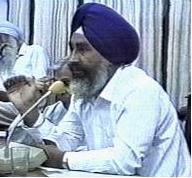 One man who took it upon himself to begin the counting was the great martyr Sardar Jaswant Singh Khalra. Last year after many many years, a rare video of his speech (delivered at Dixie Gurduara in the mid 1990's) was shown in Gurduaras in Toronto during the November Pogrom Memorial programs which also introduced Sardarni Jaskaran Kaur and Sardar Sukhman Singh of ENSAAF to the Toronto sangat. Now finally Shiromani Khalsa Dal has uploaded it on their website for free download. I urge every single one of you to download it and listen to it very carefully. The subject is clear - Human Rights. The lesson is clear - Stand up for your Rights. The message is clear - Never Forget our Martyrs.
I also refer everyone to a previous post - "I knew not then..."
Saturday, June 03, 2006
Sikh History - Still a sealed book...
As I have mentioned before, all aspects of Sikhi can only be understood from a gurmat perspective. And gurmat is only understood if analyzed from a multi-dimensional point of view. Gurmat is the way of the Guru as manifested in bani (scripture), tavarikh (history) and rahit (discipline). It is difficult, rather impossible, to understand our gurmat principles without all these three spheres intertwined to make up the whole. The issue is that none of the three spheres of interpretation have been completely unfurled in an appreciable way to show the true beauty of Gurmat. Prof. Puran Singh, in the early 1900's, explains how our history was not properly understood. Such is the case today I am sure. He says, and I have annotated with footnotes (N):
This month (June or really Jeth and Harh according to the Nanakshahi calendar) is full of Sikh history (like all months). Which stories did we hear in our grandmother's lap? From across the study table from grandpa? What do we remember from the soothing tales our mothers would relate while combing our kes? Or when father came back from work and after reciting the evening Sodar? If we haven't experienced something like that...well its about time we create our own destiny, and live our living history.
-------------
(1) - sina basina - the traditional way of the propagation of Sikh history to progeny would be when the children rested in the lap of grandparents and parents. The sakhis were sort of imbibed in them almost via osmosis (as was bani and the discpline of the Khalsa primarily of Uncut Hair).
(2) - Kavi Santokh Singh's Suraj Prakash Granth was discussed and elaborated on within our Gurduaras. A more enhanced discourse mechanism of this treasure of Sikh history is needed today.
(3) - Bhai Vir Singh was really the inspiration which was the deciding factor for Prof. Puran Singh to commit to Sikhi and become a member of the Khalsa. It was also Bhai Vir Singh's literary works which reinvigorated the relationship of Sikhs to their history in the heydays of the Singh Sabha movement.
(4) - Indeed if Sikh history is read with keeping bani in mind as the interpretative tool and applied to our daily rahit, then mere reading of our history will make our heart beat faster and raise our spirits such that no power on earth can stop our progress and men and women ready to serve humankind.
(5) - Alas, our simple and rugged Gurduaras in the land of the Gurus as well as in the Diaspora are becoming elaborate palaces where the humility and sanctity of historical events are being transformed into parades of false materialistic glory. We surely must be making some mistake if today we visit Fatehgarh Sahib and have no clue or idea of the actual location where the chote sahibzade were bricked alive!
"The history of the Sikh spirit, in which lies the true and only right interpretation of the Guru's Word, is still a sealed book. The secret love of the people for the Guru is buried in their bosoms, and so far it has been transmitted only as a holy passion from generation to generation (1). It is that invisible faith which flourishes in the shade. For the people the person of the Guru is the only fact of the soul. I love Him. I die for Him. Why ask me why? I love. He loves me. That is all. Our history? This much. How he was put in a cradle and and rocked, how he talked as a child and as a boy; what games he played; how he looked when young; how he looked sitting on the ground, or discoursed; what words fell from his lips; what replies he gave to questions; how his glances dispelled doubts; the stories of his inspiring faith, of sowing heroism in others, all little details of his life which our poets like Bhai Santokh Singh (2) and Bhai Vir Singh (3) have gathered for us, all this is our history. We are never tired of listening to its endless repetition, now laughing, now weeping, now longing to see him, to hear about him. This is what we call history, which whenever read, strikes sparks of love in our soul (4). Through a flood of tears of love we see our Gurus. The frail clay mounds and mud walls of our Gurudwaras encase immortal memories (5): perishable materials glow for us with imperishable visitors. We see them in our soul...."
This month (June or really Jeth and Harh according to the Nanakshahi calendar) is full of Sikh history (like all months). Which stories did we hear in our grandmother's lap? From across the study table from grandpa? What do we remember from the soothing tales our mothers would relate while combing our kes? Or when father came back from work and after reciting the evening Sodar? If we haven't experienced something like that...well its about time we create our own destiny, and live our living history.
-------------
(1) - sina basina - the traditional way of the propagation of Sikh history to progeny would be when the children rested in the lap of grandparents and parents. The sakhis were sort of imbibed in them almost via osmosis (as was bani and the discpline of the Khalsa primarily of Uncut Hair).
(2) - Kavi Santokh Singh's Suraj Prakash Granth was discussed and elaborated on within our Gurduaras. A more enhanced discourse mechanism of this treasure of Sikh history is needed today.
(3) - Bhai Vir Singh was really the inspiration which was the deciding factor for Prof. Puran Singh to commit to Sikhi and become a member of the Khalsa. It was also Bhai Vir Singh's literary works which reinvigorated the relationship of Sikhs to their history in the heydays of the Singh Sabha movement.
(4) - Indeed if Sikh history is read with keeping bani in mind as the interpretative tool and applied to our daily rahit, then mere reading of our history will make our heart beat faster and raise our spirits such that no power on earth can stop our progress and men and women ready to serve humankind.
(5) - Alas, our simple and rugged Gurduaras in the land of the Gurus as well as in the Diaspora are becoming elaborate palaces where the humility and sanctity of historical events are being transformed into parades of false materialistic glory. We surely must be making some mistake if today we visit Fatehgarh Sahib and have no clue or idea of the actual location where the chote sahibzade were bricked alive!
Friday, June 02, 2006
History - Freedom and Justice
All months are the same; none of them is more special or significant than the other. Nevertheless, the month of June is quite significant for us Sikhs. The historical incidents that took place during this month have an interesting theme - the fight for freedom and justice.
June
Interesting, eh?
So, time for us to reflect. Upcoming articles this month - 1) short quote of Prof. Puran Singh on History. 2) Repost of "I knew not then", 3) The Crown of Martyrs...etc.
Remain in Carhdi Kala!
June
- Shahidi Gurpurab Panjve Patshah - Martyrdom day of the Fifth Master (1606)
- Gurgadi and Shaster dharan divas Cheve Patshah - Enthronement and Donning the Sword of Miri Piri day of the Sixth Master (1606)
- Shahidi Baba Banda Singh Bahadur - Martyrdom/torture of Banda Singh Bahadur and hundreds of Sikhs in Delhi (1716)
- Shahidi Bhai Mani Singh ji - Martyrdom of Bhai Mani Singh (1737)
- Shahidi Bhai Taru Singh - Martyrdom of Bhai Taru Singh - scalped alive (1745)**
- Chota Ghalughara - the Smaller Holocaust or carnage (1746)
- Tija Ghalughara - the Third Holocaust or carnage (1984 - battle of Amritsar - Indian Army vs. Sikh Army)
- Vaidya nu Sodna - Delivery of Justice to Gen. Vaidya by Sukha and Jinda (1985)
- Stop Genocide|Save Darfur by sikhsagainstgenocide.org (2006 - history in the making)
- Many many other historical and contemporary incidents that I have missed - [goes here].
Interesting, eh?
So, time for us to reflect. Upcoming articles this month - 1) short quote of Prof. Puran Singh on History. 2) Repost of "I knew not then", 3) The Crown of Martyrs...etc.
Remain in Carhdi Kala!
Friday, May 26, 2006
Awareness - Killercoke.org
I make a concerted effort to purchase environment friendly, organic and natural products. It is quite easy to do here in Europe. European Union is quite strict about its GM (genetically modified) foods policy. All sugar, rice, milk, butter, as much veggies, even my salt and pepper are either organic or natural in my kitchen. And you all know I am a wicked cook!
Then there is another aspect of "aware consumption". Coca Cola has been allegedly implicated in murders and human rights violations of Union workers in Columbia, South America and elsewhere too. Check out www.killercoke.org. There is a world wide protest againts Coca Cola and a boycott of the same. But I like a cola with my pizza or sometime with my wasabi coated green peas. So here comes "Afri Cola".

It is a German local cola that has been around since 1931. I actually like the taste compared to Coca Cola.
Don't worry...I am not addicted to Coke or any other cola for that matter. Once in a while a cola is refreshing. My daily staple of liquid beverages is: 1 glass of organic milk for breakfast, 1 glass of apple juice at lunch (this is not organic because its from the cafetria at work), 1 glass of orange juice (usually organic) at dinner...few glasses of water (I don't drink enough water...I know.) and 1 cup of Organic FAIR TRADE coffee preferably fresh ground and brewed myself at home, never more than 2 in one day if offered at work.
Very different from my usual posts...but hey...I have found an alternate to Coca Cola (Africola!), because I don't feel right partaking in it any more...apparently you can order Afri Cola over the Web in North America too.
Then there is another aspect of "aware consumption". Coca Cola has been allegedly implicated in murders and human rights violations of Union workers in Columbia, South America and elsewhere too. Check out www.killercoke.org. There is a world wide protest againts Coca Cola and a boycott of the same. But I like a cola with my pizza or sometime with my wasabi coated green peas. So here comes "Afri Cola".

It is a German local cola that has been around since 1931. I actually like the taste compared to Coca Cola.
Don't worry...I am not addicted to Coke or any other cola for that matter. Once in a while a cola is refreshing. My daily staple of liquid beverages is: 1 glass of organic milk for breakfast, 1 glass of apple juice at lunch (this is not organic because its from the cafetria at work), 1 glass of orange juice (usually organic) at dinner...few glasses of water (I don't drink enough water...I know.) and 1 cup of Organic FAIR TRADE coffee preferably fresh ground and brewed myself at home, never more than 2 in one day if offered at work.
Very different from my usual posts...but hey...I have found an alternate to Coca Cola (Africola!), because I don't feel right partaking in it any more...apparently you can order Afri Cola over the Web in North America too.
Thursday, May 25, 2006
Door knockers - Lion with a ring
What is this European fascination with the head of a lion with a ring through its teeth? I was in Rome (Italy), Salzburg (Austria) and Venice (Italy) recently. Out of my hundreds of photos thought I'd share these ones first.
 Rome, Italy - don't remember where exactly. But look carefully - there are many like these.
 Venice, Italy. Randomly walking through the narrow streets. An ornate well kept door. And there it was again.
 I visited Salzburg, Austria. Birthplace of the great Wolfgang Amadeus Mozart and sight of the classic movie "The Sound of Music". In this one the ring is actually a curled up snake. Fascinating eh? (The Canadian in me says...)
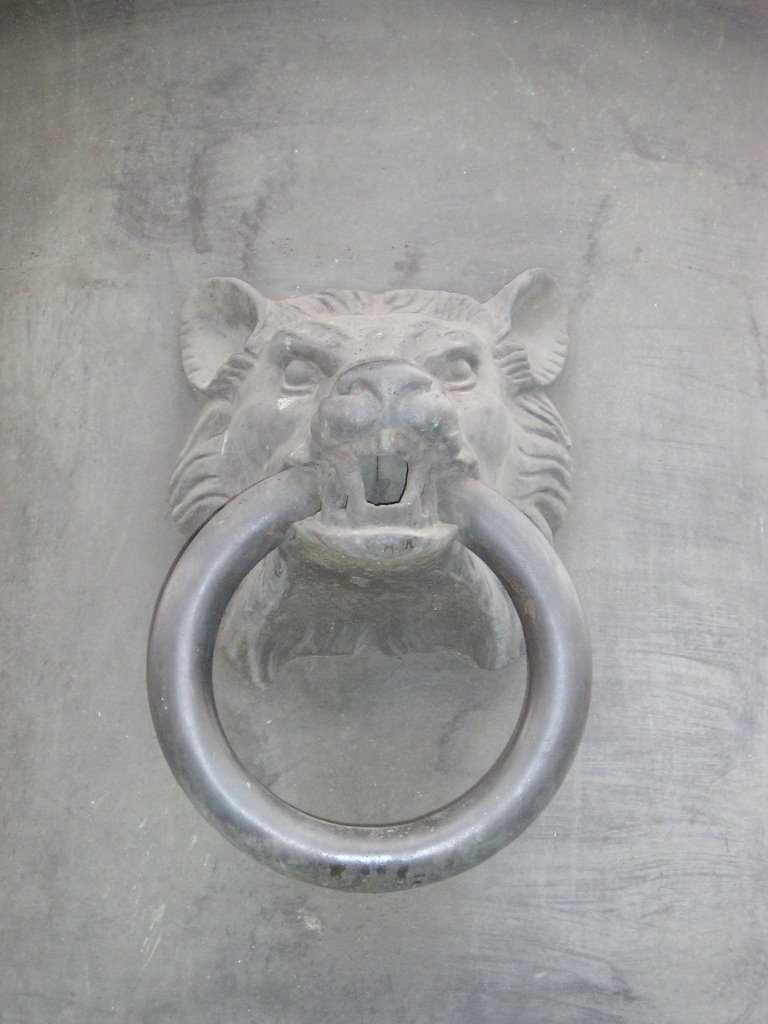 Rome, Italy - don't remember where exactly. But look carefully - there are many like these.
 Venice, Italy. Randomly walking through the narrow streets. An ornate well kept door. And there it was again.
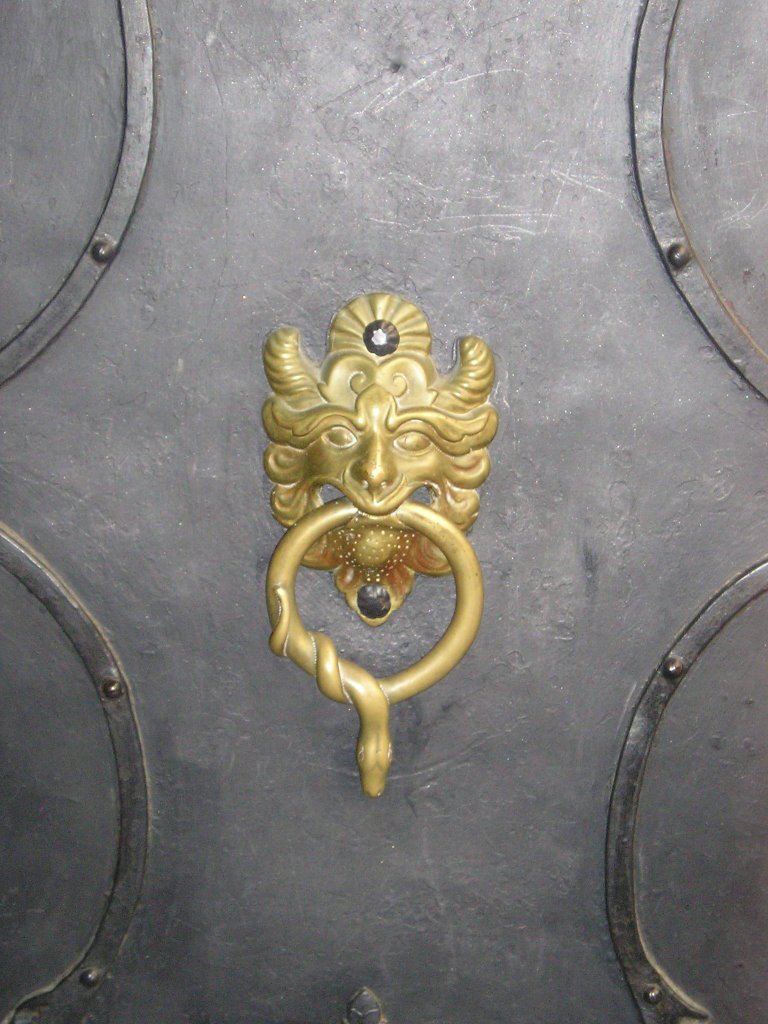 I visited Salzburg, Austria. Birthplace of the great Wolfgang Amadeus Mozart and sight of the classic movie "The Sound of Music". In this one the ring is actually a curled up snake. Fascinating eh? (The Canadian in me says...)
Saturday, May 20, 2006
The Ballad of Natural Beauty
by the The Connoisseur of Nature and the Universe
(To be sung in Raga Dhanasri. From the mouth of Nanak I)
The sky is a plate and in that plate the sun and moon become the lamps, the collection of stars in the universe shine like the pearls
The fresh sandalwood infused aromatic air of the mountain (malya) is like the incense, and in praise of the jot-rup Vahiguru, all vegetation is like the flower offerings
How can your arti be done – O how wondrous is the arti which is happening now. O your arti is being done Emancipator of birth and death (fear)
The unstruck sabad is the resounding drum (being played in your glory) – Pause
Your face are thousands yet no one (particular one) is yours
Thousand pure feet are yours, yet not even one foot
Without a nose, yet thousands are your noses
This is the way the drama of yours attracts me
In every heart there is light and that light is you
By the light that is Vahiguru, every soul is illumined
It is through the Guru’s teachings that this light of Vahiguru is manifest
What is pleasing to you Vahiguru, that is the best arti.
O Vahiguru, my mind yearns for your Lotus feet
As the honey bee yearns for the nectar of flowers
I thirst for you O Vahiguru, day and night
Nanak, the sarang – sparrow hawk – asks for the drop of water straight from you Vahiguru
So that he may be at peace by internalizing your presence
(To be sung in Raga Dhanasri. From the mouth of Nanak I)
Sunday, May 07, 2006
Spirit of the Sikh - Meditations on Religion and the Spiritual Experience
Yes, this is Prof. Puran Singh's 3 volume meditational expression reflected onto paper of his experience with Sikhi - written between 1927 and 1930. The forward to Part I eloquently describes:
Enjoy and Carhdi Kala!
---------------
The Song of the Akali
By The Swordsman that goes before the Sun
Spirit of the Sikh, as its title would indicate, is the author's expression of devotional passion arising out of the teachings of the holy Gurus, the religious history of Sikhism and his understanding of the ideals underlying the practice of Sikh faith.....I just read Otpreka Singh's blog in which he shared a modern westerner's view of saint-warrior. Then I remembered a piece from Spirit of the Sikh. I had glanced at this poem/prose-poem of Prof. Puran Singh a while ago. Something in it had stuck with me. Maybe it was:
As the theme of Spirit of the Sikh is the expression of fervent devotion to the holy Gurus in lyrical outbursts in prose charged with deep emotion, it time and again becomes fragments of prose poems.....
"I am born of the flash of the Sword. And my speech is thunder; I do not compromise with darkness, I tear its belly with my rapiers of lightning;"Or then again, maybe it was:
Put a sword in the belt of the Sikh youth,But anyway, I thought I should type out the poem in its entirety. His words are fascinating. In almost all his writing he includes bani, tavarikh, and rahat (scripture, history and discipline). And as some of you know I always insist that in order to understand gurmat it is imperitive to do a multi-dimensional analysis of the subject from these three angles (bani, tavarikh, and rahat).
And give him the draught stirred with the Guru's dagger,
And let his soul shine as sharp as the edge of lightning.
And he should stand up alone in the universe to match the
strength of his arms with the arms of the Sun.
Enjoy and Carhdi Kala!
---------------
The Song of the Akali
By The Swordsman that goes before the Sun
I am God's Temple,
Brother of the Way! Let me kiss
Your feet, let me rub on
my forehead the dust
of your path.
Over us is God, Brother! Over us is He:
Are you thirsty?
I shall run to the well, throw the bucket in, slipping a long hemp line with
speed and draw it up full of water for you;
I shall bring you the draught, sweet and cool to refresh your soul by my
humble love-perfumed service;
You shall drink and rest and lie quiet under the shade of a road-side tree;
I shall massage your tired limbs, and kiss you in my soul as you sleep by the roadside!
Over us is God, Brother! Over us is He.
* * * * *
Are you hungry?
I have a handmil, to grind for you wheat, I will knead the flour,
and bake it into bread for you.
There is plenty, Brother, there is plenty.
Are you naked?
My mother and sister and wife have gathered the cotton of Punjab,
they ginned it and spun it and wove this yarn of love into cloth for you.
Wear them and be glad.
They were made for you!
There is Guru's Plenty, Brother, Plenty!
* * * * *
The fingers of the Sikh man and woman work --
Work work, work ceaselessly.
We create wealth, it is the product of our labour in the love of the Guru's commonwealth.
And know, all is added unto us.
There is Guru's Plenty, Brother, Plenty!
* * * * *
I am of the Country of Man,
I was born in the Heart of Man,
This is my native land!
Come Brother of the way, come;
I am on way to Hari Mandir.
I see you are the Temple yourself.
O Disciple of the Guru!
What golden domes resound in you!
I hear the song of eternal comradeship in you.
Who are you? I feel you are a brother to me, born of the same
mother, that have met me after an age-long separation!
* * * * *
Come, Brother, come.
Do not be fettered here with mere dreams;
there yonder is the Hari Mandir, around which the blue lakes of nectar wave
day and night;
There is the song of the Guru! whose echoes are in me.
Come, Brother! come.
I am on way to the Golden Temple.
* * * * *
"I see the nectarean lakes in your eyes,
You are the music of fellowship."
I see the light of God on your face.
Slacken your pace,
Let me behold you,
Be with me for a while, O strangest of strange Men!
Good-bye. Remember me when you get weary of collecting
poppies and staining your hands with their blood.
Remember me! I am of the City of Joy.
My name is -- "Blessed be Guru Gobind Singh".
All other names are illusions, conventions, self-deceptions.
Remember this one Hymn--the Name has in it the secret of life.
This is a star burning day and night in my eyes.
Look at the star,
Follow the gleam.
And passion, O brother of the Way.
Life is a glorious passing away.
I am born of the flash of the Sword.
And my speech is thunder;
I do not compromise with darkness, I tear its belly with my rapiers of lightning;
Terrible is the sight of the dazzling tangle of the flashes of my
rapless, striking right and left and destroying.
You are not born of steel?
No!!
The sheen of steel is of the colour of the soul.
And lighting of the Sword-flash is of the gleam Unknown.
* * * * *
Only little birds quiver, their eyes are dazzled and they hide in
their nests when the sword-like moves on the face of the
restless blades of lightning;
But I tell you the smiting scimitar has in it the white sparkle of
the bow of God.
Put a sword in the belt of the Sikh youth,
And give him the draught stirred with the Guru's dagger,
And let his soul shine as sharp as the edge of lightning.
And he should stand up alone in the universe to match the
strength of his arms with the arms of the Sun.
* * * * *
We fell as a rain of Kirpan-flashes on the ghosts of darkness;
Do you remember when the invaders from the North came and
laid chains on the tender wrists of hundreds of Hindu
Punjabi wives and daughters and marched them as
bondwomen bound for Kabul?
When on the banks of the Chenab the miscreants met the Sword-
Tempest of the Khalsa, and the seperated birdmates were
rescued from the claws of the birds of prey, and they met
again, those from whom they had been cruelly separated!
* * * * *
This life is a theatre of war,
And I am strangely excited when singing war-songs,
And when I die, there too I fight my way through a host of black
ghosts yonder to the shining ones;
As long as a single man has the way of the ferocious tiger and
the wolf in him still unforgot, I cannot lay down my Kirpan,
nor unstring my bow.
God is a little child and I have to fight saving Him from all
harm that comes from these tigers (who) prowl on the earth in
the guise of men.
I do not sleep and dream when I am on the battlements,
And when I die, I die to save my God who is a little child.
* * * * *
Brother of the Way! Let me kiss
Your feet, let me rub on
my forehead the dust
of your path.
Over us is God, Brother! Over us is He:
Are you thirsty?
I shall run to the well, throw the bucket in, slipping a long hemp line with
speed and draw it up full of water for you;
I shall bring you the draught, sweet and cool to refresh your soul by my
humble love-perfumed service;
You shall drink and rest and lie quiet under the shade of a road-side tree;
I shall massage your tired limbs, and kiss you in my soul as you sleep by the roadside!
Over us is God, Brother! Over us is He.
* * * * *
Are you hungry?
I have a handmil, to grind for you wheat, I will knead the flour,
and bake it into bread for you.
There is plenty, Brother, there is plenty.
Are you naked?
My mother and sister and wife have gathered the cotton of Punjab,
they ginned it and spun it and wove this yarn of love into cloth for you.
Wear them and be glad.
They were made for you!
There is Guru's Plenty, Brother, Plenty!
* * * * *
The fingers of the Sikh man and woman work --
Work work, work ceaselessly.
We create wealth, it is the product of our labour in the love of the Guru's commonwealth.
And know, all is added unto us.
There is Guru's Plenty, Brother, Plenty!
* * * * *
I am of the Country of Man,
I was born in the Heart of Man,
This is my native land!
Come Brother of the way, come;
I am on way to Hari Mandir.
I see you are the Temple yourself.
O Disciple of the Guru!
What golden domes resound in you!
I hear the song of eternal comradeship in you.
Who are you? I feel you are a brother to me, born of the same
mother, that have met me after an age-long separation!
* * * * *
Come, Brother, come.
Do not be fettered here with mere dreams;
there yonder is the Hari Mandir, around which the blue lakes of nectar wave
day and night;
There is the song of the Guru! whose echoes are in me.
Come, Brother! come.
I am on way to the Golden Temple.
* * * * *
"I see the nectarean lakes in your eyes,
You are the music of fellowship."
I see the light of God on your face.
Slacken your pace,
Let me behold you,
Be with me for a while, O strangest of strange Men!
Good-bye. Remember me when you get weary of collecting
poppies and staining your hands with their blood.
Remember me! I am of the City of Joy.
My name is -- "Blessed be Guru Gobind Singh".
All other names are illusions, conventions, self-deceptions.
Remember this one Hymn--the Name has in it the secret of life.
This is a star burning day and night in my eyes.
Look at the star,
Follow the gleam.
And passion, O brother of the Way.
Life is a glorious passing away.
I am born of the flash of the Sword.
And my speech is thunder;
I do not compromise with darkness, I tear its belly with my rapiers of lightning;
Terrible is the sight of the dazzling tangle of the flashes of my
rapless, striking right and left and destroying.
You are not born of steel?
No!!
The sheen of steel is of the colour of the soul.
And lighting of the Sword-flash is of the gleam Unknown.
* * * * *
Only little birds quiver, their eyes are dazzled and they hide in
their nests when the sword-like moves on the face of the
restless blades of lightning;
But I tell you the smiting scimitar has in it the white sparkle of
the bow of God.
Put a sword in the belt of the Sikh youth,
And give him the draught stirred with the Guru's dagger,
And let his soul shine as sharp as the edge of lightning.
And he should stand up alone in the universe to match the
strength of his arms with the arms of the Sun.
* * * * *
We fell as a rain of Kirpan-flashes on the ghosts of darkness;
Do you remember when the invaders from the North came and
laid chains on the tender wrists of hundreds of Hindu
Punjabi wives and daughters and marched them as
bondwomen bound for Kabul?
When on the banks of the Chenab the miscreants met the Sword-
Tempest of the Khalsa, and the seperated birdmates were
rescued from the claws of the birds of prey, and they met
again, those from whom they had been cruelly separated!
* * * * *
This life is a theatre of war,
And I am strangely excited when singing war-songs,
And when I die, there too I fight my way through a host of black
ghosts yonder to the shining ones;
As long as a single man has the way of the ferocious tiger and
the wolf in him still unforgot, I cannot lay down my Kirpan,
nor unstring my bow.
God is a little child and I have to fight saving Him from all
harm that comes from these tigers (who) prowl on the earth in
the guise of men.
I do not sleep and dream when I am on the battlements,
And when I die, I die to save my God who is a little child.
* * * * *
Subscribe to:
Posts (Atom)